

Lights Out | What a Ten-Year Community's Circuit Breaker Revealed中英
Governance notes on Lezismore's two weeks with the lights out in mid-June 2026
On June 9, 2026, that day, the Lezismore community suddenly closed, without an announcement or explanation. This is a self-hosted community with thirty to ninety thousand unique visitors a month, with no active presence on Meta or other mainstream social media.
As an anonymous, independently self-hosted, sex-positive community of sexual minorities, this was of course not our first closure or unexpected event. We came into being in 2015 through being "expelled from lesbian circles." This time, however, it was not because we had been banned by mainstream platforms, not because our hosting provider shut us down, not because a major external event forced a pause; but because, for the first time in more than ten years, "the site" had manually brought itself to a stop.
No server failure, no major external event, no technical problem.
The real reason behind this incident, to put it more safely, would be: an overload of the infrastructure's circuit breaker.
After thirteen days of lights out and a pause, the community reopened. During the pause, a pause page replaced the community entrance.
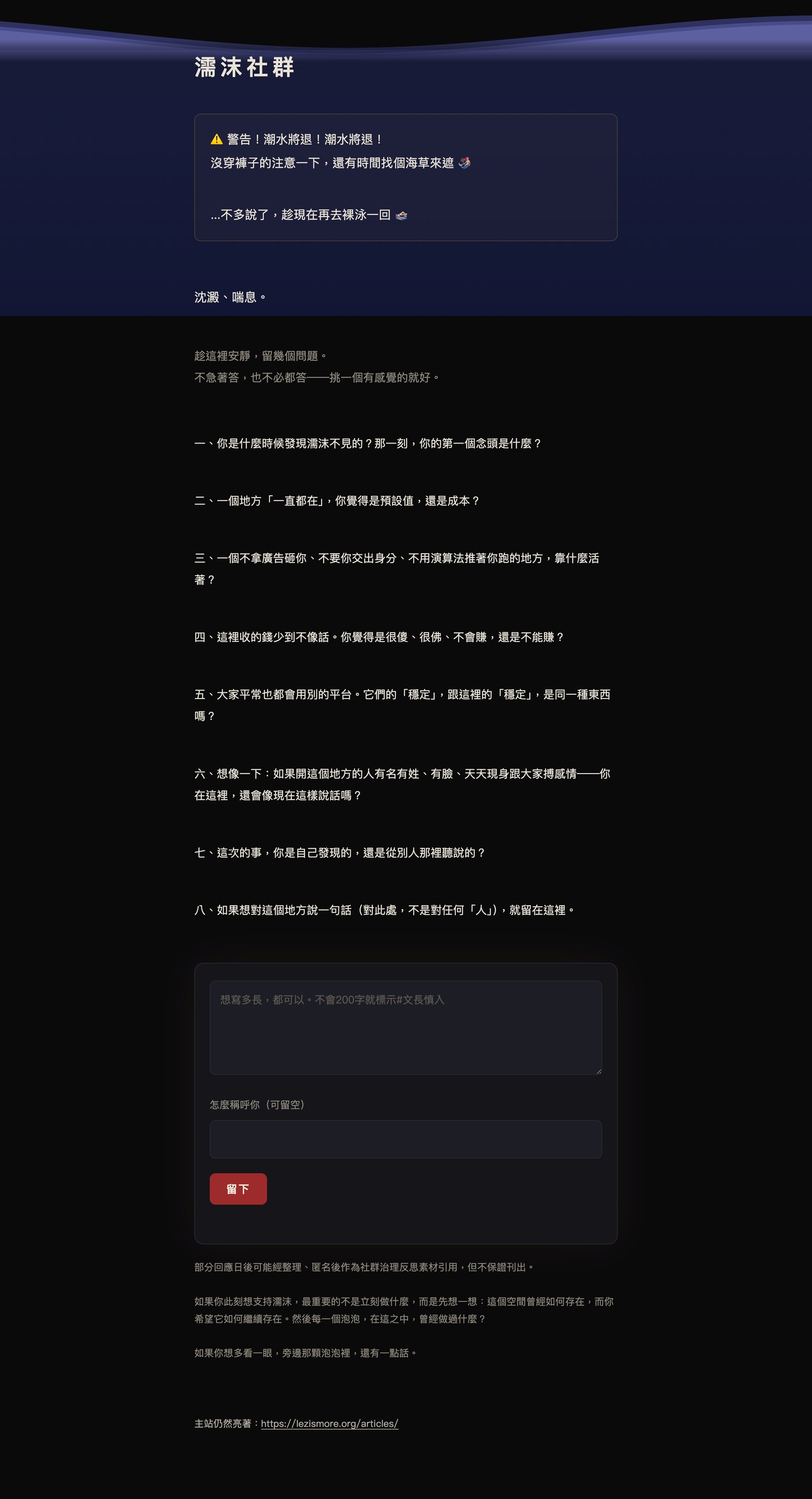
At first, there were only eight questions on the first page. None of the explanations commonly offered by a "brand" or a "community."
After a few days, the page grew longer, deeper, and more layered. Each layer down brought more new information and new comments.
By the time of writing, this "pause page" had received seven hundred anonymous comments.
The person writing this is the steward (me). I read every one of those seven hundred comments myself, with my own eyes. I also chose the quotations that follow. The selection principle was: every layer is represented, the fiercest and the deepest are both here, and each comment comes with its full text, so readers can judge for themselves whether anything has been taken out of context.
What everyone saw above the comment box on the pause page was: anonymous comments are not guaranteed publication; some may be made public as material for governance. The anonymous comment form did not ask for or collect personal information, and all comments underwent basic manual de-identification before publication. (For example, personal information such as account IDs and geographical locations was de-identified. Comments that said "please do not publish" were not published.)
1. Stop: Infrastructure Becomes Visible When the Breaker Trips
I use "circuit breaker overload" to describe the act of turning out the lights and pausing because it starts from "the site's" perspective.
What the community's bubbles (as members call themselves) experienced was this: they could not enter their usual community. There was only a pause page and eight questions. The main site was still there. The site had given no advance notice. Asking friends brought scattered guesses, but no one knew the real reason. Lezismore does have several mainstream social media accounts (a Facebook page, Instagram, Threads, X, and so on), but they have not been updated for years. Some are entirely empty.
In the first 14 hours after the lights went out, 3 people came to ask through channels outside the site. Bubbles used their usual LINE and Instagram to ask: is the website broken?
A website with thirty to ninety thousand unique visitors a month, down for 14 hours, and only 3 people took the initiative to ask — in an age of traffic-driven economics, that number can easily be read as a hurtful answer: "It can't get popular. Nobody cares."
But for years, Lezismore's everyday practice has been to maintain no active presence on mainstream social media, post no "daily updates," make no effort to "keep reminding people we exist," and avoid promoting a personal brand as much as possible. Under these conditions, "taking the initiative to ask after an outage" involves enormous friction: to ask a single question, you first have to leave the website, find another channel yourself, and then disturb someone whose disposition and circumstances you do not know.
At the same time, Lezismore has spent years making "no rushing, no disturbing" part of the community's culture and makeup. The bubbles' own responses also show what this space has given them. Some later comments bear this out:
I thought it was my own browser glitching, deleted it and reopened it, and found it still wouldn't load; then I figured maybe the site engineers hadn't noticed yet, and since I knew the people maintaining the community were doing it unpaid, I was willing to wait it out quietly; a while later, this page popped up…
The Entryway・June 12 07:45 q1
I found out Lezismore was gone because I came to reply to a DM.
The Entryway・June 10 10:26 q2
At first I thought it was a bad signal.
But a few days later I realized the site seemed to have been shut down.
I noticed the site was down right away, kept refreshing for several days before realizing it really wasn't opening.
Ebb Tide・June 21 19:11 q3
A few hours later, I checked Cloudflare. On the first day with the lights out, 3,941 unique visitors came to this closed door. That figure includes bot traffic. One day alone tells us little; a comparison becomes meaningful when we set three weeks from before, during, and after the pause side by side:
The number of people who came during the week the site was closed was almost the same as the week before and the week after reopening. What fell was the request count: the automated conversation between the community software and machines. People's routes here did not change because the door was closed. These numbers cannot answer "do they care?" They answer a question about dependence: how many people's daily lives this place is woven into.
From the bubbles' perspective, opening Lezismore usually means staying inside "the community," without ever thinking of "the main site," because it has no direct bearing on most people's need to meet others. Browsing, scrolling, making friends, dating, writing, creating. Ordinary daily life. Even more people say nothing at all and simply lurk and read. Here, there is no culture of chasing likes or exposure, no habit of following personal brands. Just "life."
Other platforms are all fast food joints, every step rushed, like you're in a hurry to get something; Lezismore here is more like a coffee shop — I can sit down and rest, just order a hot coffee, read a book, and I can still get something out of it too, whether that's inspiration from the book, someone else's story overheard in the coffee shop, or an offhand warm remark from the staff handing over my order.
The Entryway・June 13 07:07 q4
I don't know why, but using this platform never felt like pressure — maybe because it's not that commercialized, you can freely show yourself. On other dating apps, swiping left and right gets you filtered fast, so you have to package yourself up, like putting yourself up for sale on a shelf — someone glances at you once and has to decide whether to put you in their cart, it's missing warmth.
The Last・June 19 22:07 q5
no algorithm, no need to curate a persona. … unlike other apps where you have to manage your image and get fed algorithmic content just to keep you scrolling.
The Last・June 14 17:47 q6
Precisely because of this, the community's bubbles have no need to know who will handle flags today, whether the backups ran, what legal problems lie behind a feature, or who must make the final judgment on a seemingly tiny change. This is what "infrastructure" does: when it works properly, its best way of existing is to be so quiet that people forget it exists.
For an infrastructure that has run for more than ten years, the longer it is kept up and the less it competes for visibility or a say, the more "it will still open tomorrow" comes to feel like a given… until one day, it really does close.
Susan Leigh Star says infrastructure becomes visible only when it breaks down.1
From the site's perspective, the circuit breaker has tripped. Rest is needed. There is not even a trace of energy left to reply. But explaining would mean unnecessary self-disclosure and scrutiny by the community: the community would not register how the work is done, its history, or its cost, only the inconvenience. Explaining itself takes energy and brings risk. The more you explain, the more you hand the crowd the right to judge "whether you are fit for this."
On the other hand, rushing to lay out ten years of hardship all at once, while everyone is paying renewed attention to this infrastructure, would create another predicament: who wants to read a long-winded account? Screenshots, forwarding, and quotations taken out of context are secondary. The hardest part is the whole explanation becoming another kind of emotional debt: as if demanding that a group of people who "just came to use it" and "never agreed to carry any of this" must, at that moment, feel for you, understand, and give the right answer.
But if nothing were said and the site simply reopened later, the whole event would amount to no more than an outage.
What to do? At the time, the earliest pause page had only one line of status and eight questions. Three of them:
Is a place being 'always there' the default — or is it a cost?
First version of the pause page・June 9
The money collected here is embarrassingly little. Do you think that's naive, saintly, not knowing how to make money — or not being allowed to?
Imagine this: if the person who runs this place had a name, a face, and showed up every day to build rapport with everyone — would you still talk here the way you do now?
No prescribed answer, just a plain comment box. Anonymous comments went to the backend without personal information. At the very beginning, comments were not published on a wall either, so there were no other people liking, arguing, or comparing which way of putting things was more sophisticated or more correct.
"Is a place being 'always there' the default — or is it a cost?"
Of the 50 comments that explicitly answered this question, 70% said "cost," 16% said "default," and a few said "the default for users, a cost for the person maintaining it." The answers were not especially scattered. The difference lay in whose position people were looking from.
2. Ask: Friction as Design
The pause page has four layers. This structure was not "planned from the beginning." It was decided, developed, and built during the two-week pause, while I observed the community's responses.
You saw a screenshot of the first layer's eight questions earlier. At the bottom was just one comment box. Answers were not guaranteed publication. You could not see what anyone else had left. No audience, no competition for likes, no comments written for onlookers, no immediate risk of being screenshotted.
The community has long known that there are "people" behind the website managing it, so the expectation when leaving a comment was that "some administrator will see this." Anonymous comments also removed the burden of identity or performance. Without immediate publication, writers did not need to perform for an audience. The design aimed to receive words that were less burdened, more truthful, and more direct. How well did it work? As you read the other comments below, you should be able to judge for yourself.
The comment mechanism for the lights-out pause page did not store IP addresses with submissions, installed no third-party analytics or fonts, and saved no drafts. Submissions went into a private database separate from the community system (what the host sees at the network level is where the visitor counts above come from). After they arrived, the steward read every one with their own eyes, de-identified it, and assessed its content.
Then the page began to grow deeper: a second layer, a third, a fourth.
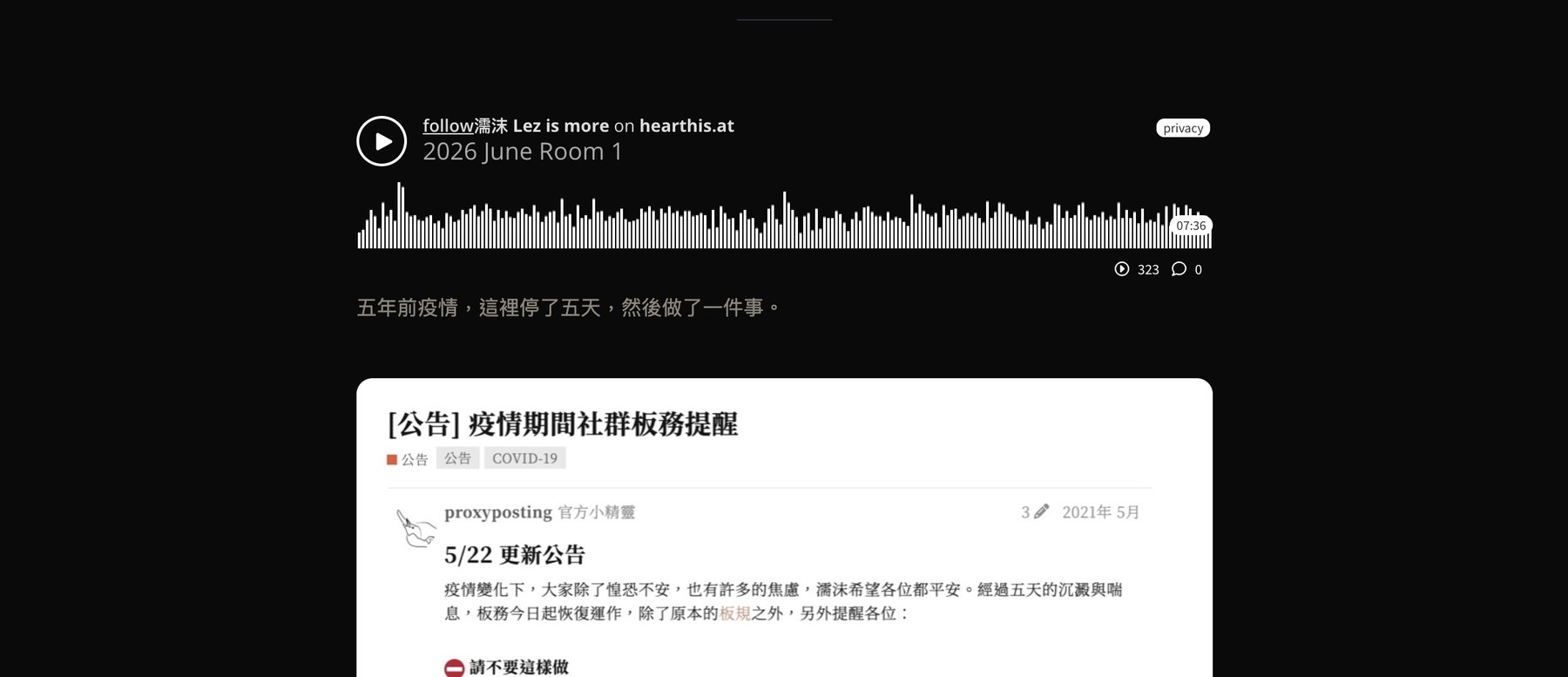

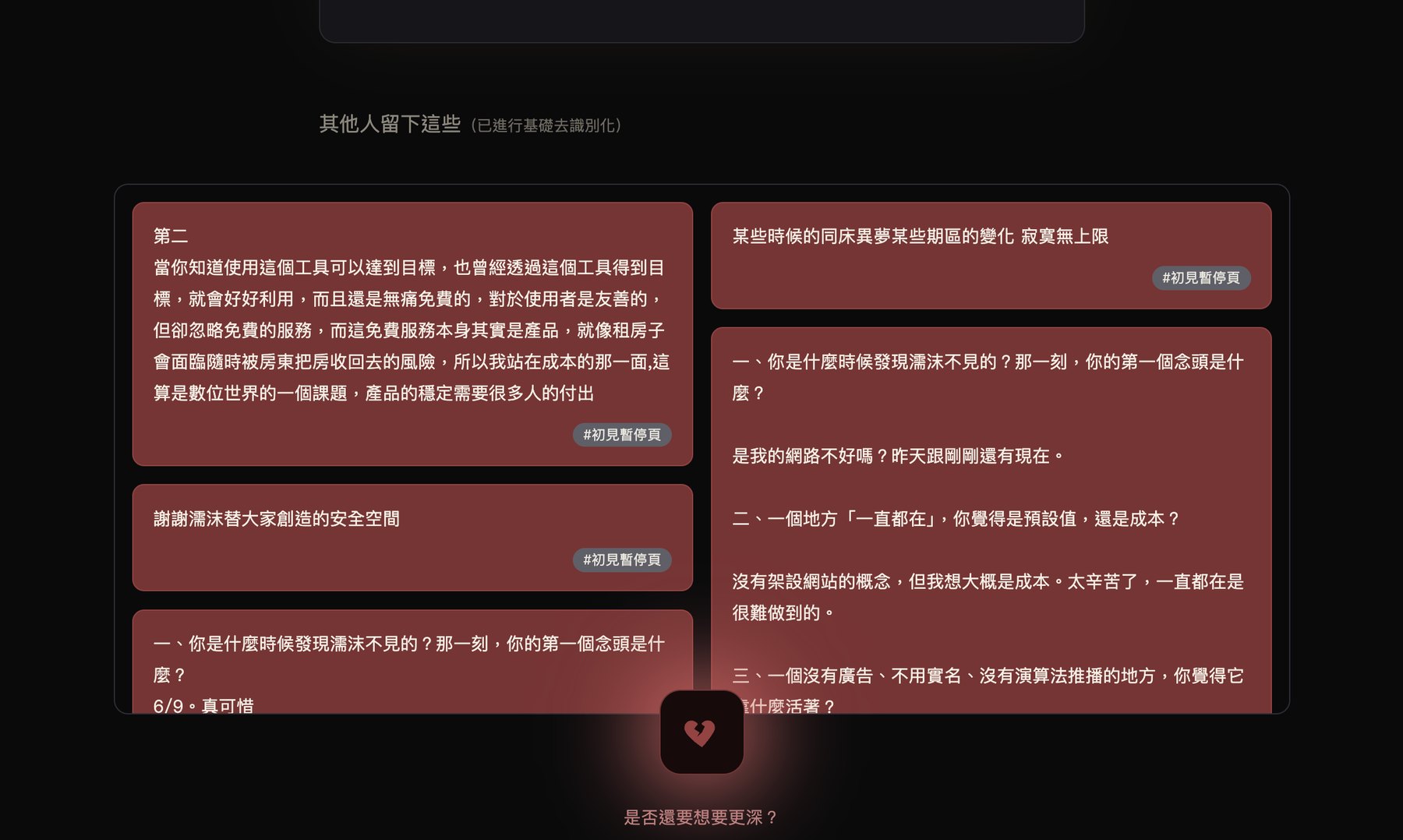

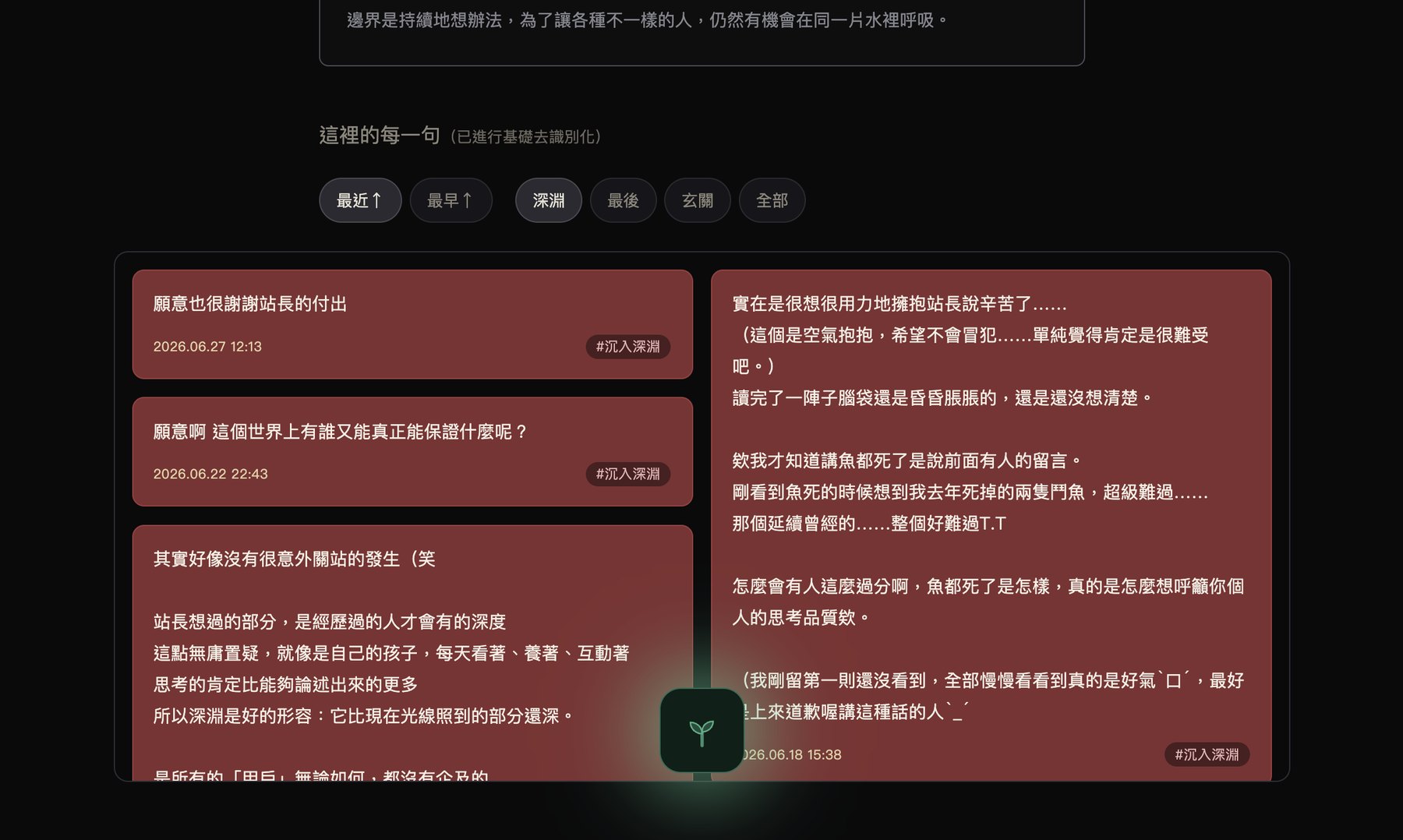
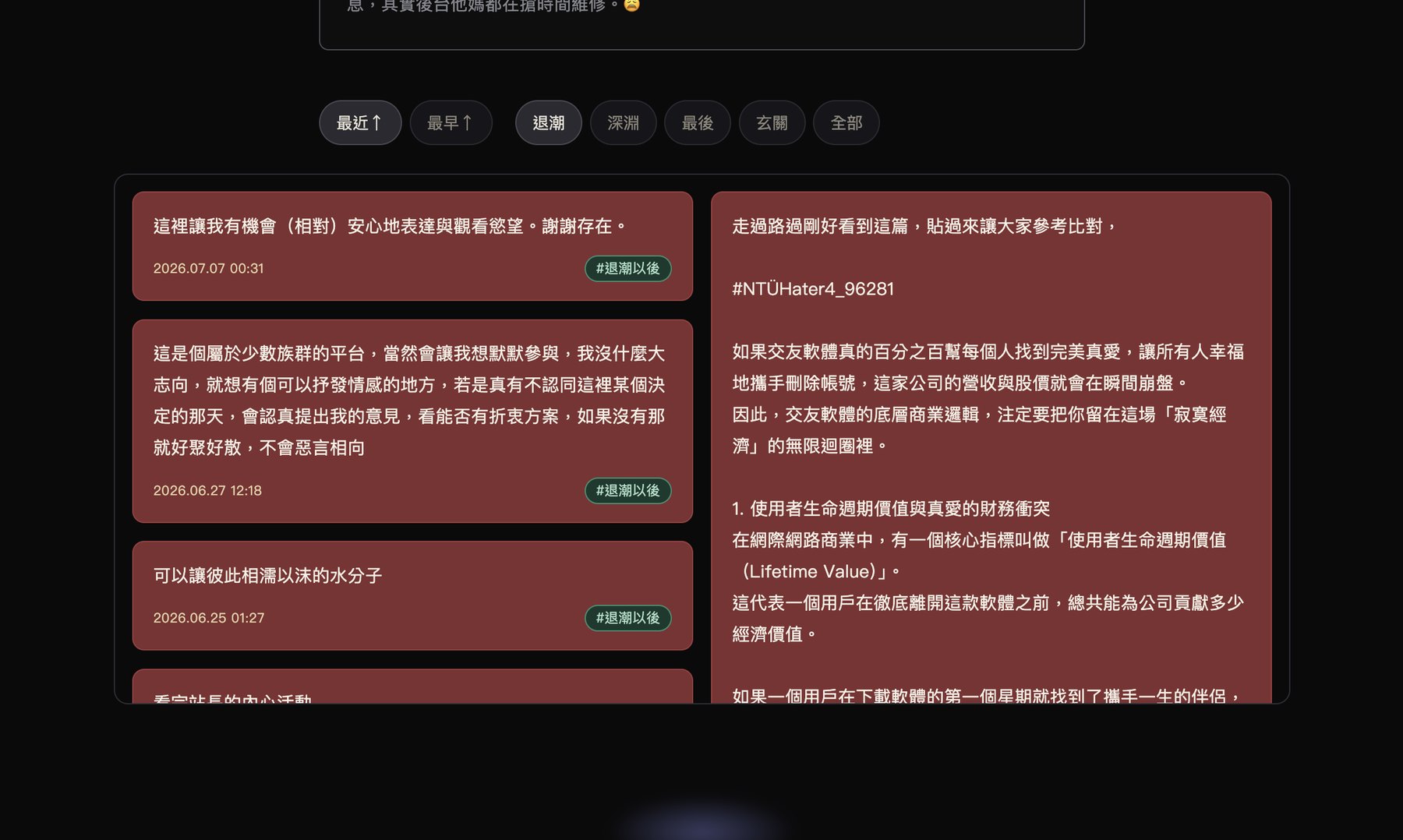
The first layer, "The Entryway": one line of status, eight questions, one comment box.
The second layer, "The Last": several rooms with audio, images, and text, briefly describing Lezismore's rules and costs. It went live on June 13.
The third layer, "The Abyss": law, boundaries, and what is carried by the position at the base of the infrastructure. It went live on June 16.
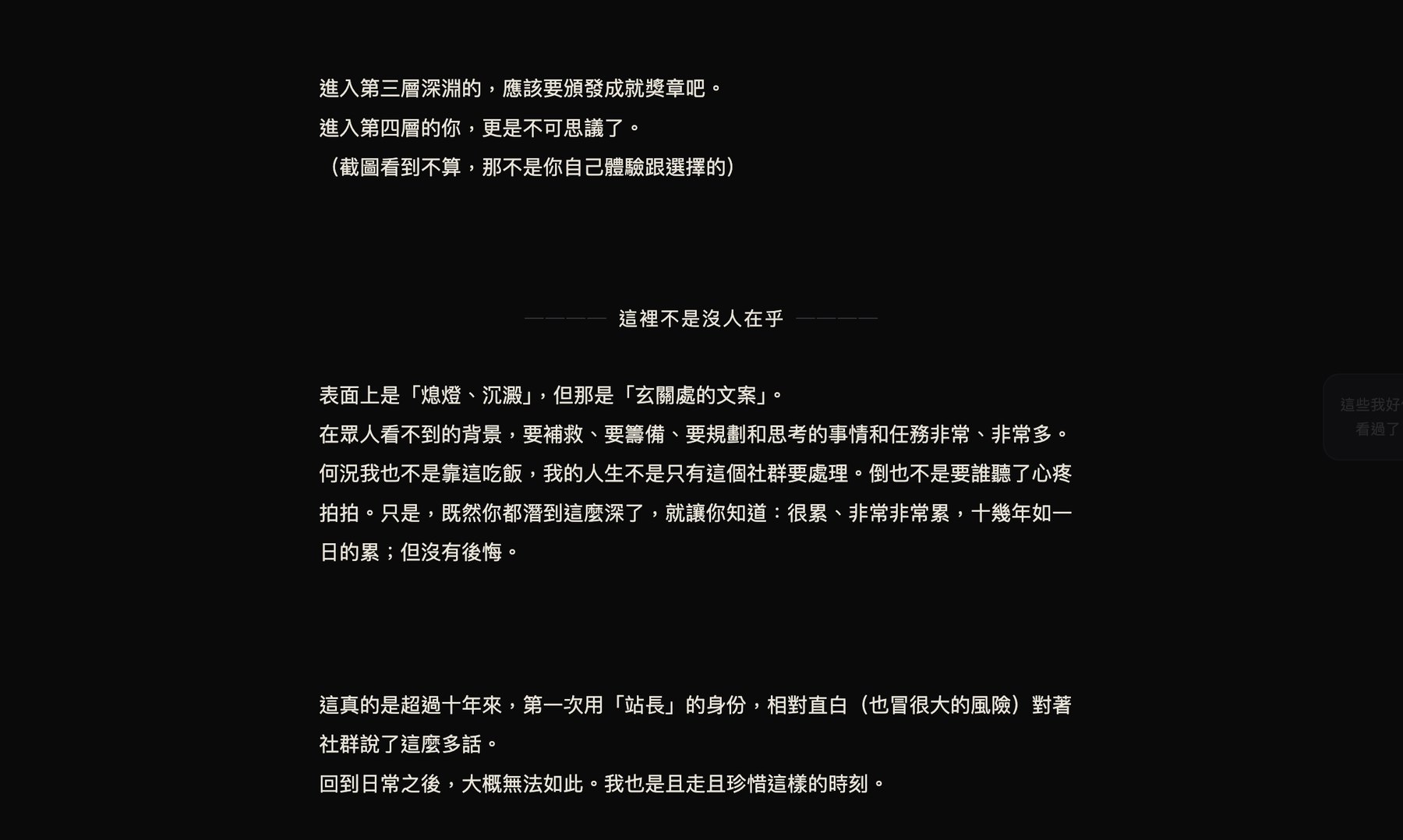
The fourth layer, "Ebb Tide," went live on June 19. It was the first time in more than ten years that I had said this much to the community as the steward, in my own voice.
The layers were separated by "time spent." There were no passwords between them, no registration, invitation code, or acquaintance needed to lead the way. For example: only after you finished reading the second layer's comments and stayed a while would a dark red heart emerge. That was the entrance to the third layer. After completing the third layer and staying another 20 seconds, a dark green sprout appeared. The entrances did not say "deeper" or "next layer." There was only color, a halo, and the rhythm of breathing.
The passage from the first layer to the second used a tide animation: as you scrolled down, the water receded, reaching the bottom and gathering into a glowing ochre bubble. That bubble was the entrance. The entire process was the opposite of a marketing funnel. Not a single word or button was selling anything. Those who had no time, did not want to read, could not be bothered, disdained reading, or simply happened to miss it naturally passed it by.
We did not force, lure, or steer anyone into staying for commercial purposes.
This bold design decision made friction and reading rhythm part of the product design. Of course, friction needs careful handling. There cannot be none at all, nor is more always better. The wait between the third and fourth layers was set at 20 seconds, slightly longer than the previous gate, to preserve the feeling of "another layer deeper," but not so long that it broke the flow or caused impatience. It needed to allow a reasonable reading pace. After all, anyone reaching the bottom of the third layer had already passed through several rounds of filtering. Making the gate take longer would only punish the most faithful readers.
The design also considered people who need "reduced motion" when reading a webpage. The tide animation became static, but the unlocking logic remained. Turning off animation would not cost them the entrance. The entrances could receive keyboard focus and be opened with Enter, with labels accessible to screen readers.
Bubbles saw through a small part of this design, and questioned it too.
Is the core goal of this whole layered series of gates to guide the bubbles into thinking about other people's thinking? … This is basically a social experiment, and I'm genuinely curious whether it'll succeed.
Ebb Tide・June 19 12:49 q7
the tone of some of the questions felt a little like it was putting the responsibility of "do you value this space" back onto the users — that carries some pressure.
If you could explain more directly what difficulties you're facing and what kind of support you need, that might draw people closer than reflective questions do.
The Entryway・June 10 01:28 q8
The second comment was left right at the entrance, in "The Entryway," by a bubble who felt pressure when confronted with those eight questions. Their criticism shows exactly what they thought they should be told, and what they had not understood before.
But they were right. "Reflective questions" do make readers more uncomfortable than a "customer-service-style announcement." The design knowingly and actively chose this. After all, the cost of spending more than ten years living as infrastructure is that "users feel nothing."
Speaking directly and publicly on the site, when most people are unprepared, can easily stir emotions or misunderstandings after only a few sentences. Too much information, and people read it wrong or skip it. So the design divided the explanation into layers without forcing everyone to read.
3. Listen: What 700 Comments Can and Cannot Show
The whole lights-out pause page was like a rough road full of friction. Add the absence of promotion or interaction on any mainstream social media, and even under all these "unfavorable" conditions, quite a few bubbles still left words here.
First, these comments were left on an interface that was "continually iterating." Every iteration affected what later bubbles would read. For example, the entire fourth layer, including its comment section, did not go live until June 19. Before then, there was no fourth layer to visit. So the structure as a whole was not a continuous "funnel."
Also, the person reading the comments was the steward. These 700 comments were completely anonymous, with no identity binding or identification mechanism, so the same person may have left several. These 700 comments can therefore show only the different words left by bubbles who reached different places during the lights-out pause.
Here is the distribution of comment counts as the page evolved over time:
Having boldly claimed earlier that I had made friction part of the design, what actually happened with the bubbles' comments?
The overall distribution of comments looks very much like "the opposite of a marketing funnel." The fourth layer (the last layer, Ebb Tide) even received more comments than the third, The Abyss. Comments grew longer with depth. Nearly half in The Entryway were under 30 characters, mostly "thank you," "thanks for the hard work," and "come back soon." In the third and fourth layers, more than half the comments exceeded 100 characters.
Some comments' positions cannot be determined directly from keywords. They need to be read and interpreted manually. For example, in response to "Is a place being 'always there' the default — or is it a cost?" someone wrote:
A place that's 'always there' can never actually be the default — it can only exist because someone nurtures it, someone cares, someone takes it seriously and holds it close. Even a park needs someone to look after and maintain it to keep going, let alone a community.
The Entryway・June 11 16:32 q9
Or this response to the final question:
The hardest thing isn't clinging to each other to survive, isn't drifting apart to forget each other, free in the rivers and lakes,
and it's certainly not clinging to each other to survive on the premise that we'll eventually forget each other, free in the rivers and lakes.The hardest thing is still being willing to cling to each other to survive, even with no countdown in sight to when we'll forget each other.
The Entryway・June 12 07:33 q10
After reading them one by one, I tagged each comment's position: explicit opposition to the site's approach, or disagreement over a particular boundary. There were 9 comments expressing explicit dissent. Eight were left in The Entryway. Here are 3:
Now that you're unhappy and want to close it, you come ask us these questions — what are you trying to get out of it? Gratitude? Or just to feel good about yourselves? … Having a real name would be better — only then could people who do evil actually be brought to justice under the law.
The Entryway・June 10 06:08 q11
From the opening, I could tell it was heading toward charging for use, and I think that's reasonable — I'd be willing to pay to keep using it. But the way it's phrased feels like emotional manipulation. … Good communication shouldn't use questions to convey your philosophy. Hang in there, I hope it comes back soon — I'll be the first to sign up as a paid member.
The Entryway・June 16 05:42 q12
I lurked on Lezismore for a long time, watching, and it never became something I was willing to give to. So, that's that.
The Entryway・June 14 14:30 q13
There is another kind of distance: not opposition, but a feeling that this place has nothing to do with you. A bubble who left comments in all four layers wrote:
I'm a trans lesbian — lesbians who can accept someone with male physiology are still a minority, and I'm also not at the age that's in demand, so I often feel like what happens on this site has nothing to do with me. After scrolling for a while I lose the motivation to keep coming back. Still, I hope this community site can keep existing.
The Last・June 20 11:40 q22
"Sexual minority" is one label. Making it real for every kind of person in the same space is far harder than a slogan. To someone who has not seen themselves continually addressed here, what the site has done amounts to nothing.
The positions in these comments cannot easily be divided into a binary of support and opposition. Someone speaking critically, for example, says in the same breath that they will be the first to pay when the site reopens. In the second layer, "The Last," a thousand-character critiqueq14 can be roughly grouped into five points: 1. Being unable to disclose details and choosing how to explain are two different things; 2. There is a gap between a platform that has long spoken as "we" and one that says "I'm the one who decides" at a critical moment; 3. The metaphor of "open dictatorship" does not fully explain the situation; 4. There are reservations about how responsibility is described; 5. The comments suggest that most users do understand that running the site costs something and are willing to discuss paying, with the most consistent request being the ability to back up their own posts. Later, another comment appeared in the third layer: someone had fed the first four points directly into AI for a third-person analysis, then pasted several thousand characters of analysis back into the third layer.q15
The bubbles proposed all kinds of ways to address the difficulties of community governance, but those approaches were mutually exclusive. For example, someone called for stricter moderation:
if possible, please set up a large management team. … Hold regular meetings to review and establish a full set of SOPs for reviewing and managing this community. … have absolute zero tolerance for members who repeatedly cross the group's bottom lines…
Ebb Tide・June 19 15:58 q16
Someone else wanted things to stay the same:
I just want to be a low-key user who makes small donations.
Ebb Tide・June 19 22:56 q17
Hope Lezismore stays as it is — I feel I can use it with fewer inhibitions this way. If it wants to grow bigger, it'll need to commercialize to be easier to manage.
In 2017, this community established the principle that its administrators would not build personal brands. Nathan Schneider uses "implicit feudalism" to describe the default structure of online communities2: the sole administrator is the sovereign. The entire lights-out pause page built a structure and layers for conversation, letting bubbles decide for themselves whether to go there, how deep to go, whether to respond, and how.
Among the comments, some strongly demanded real names, while others said they would stop using the site if real names became mandatory. Some wanted to see a proposal before deciding. Everyone had different visions of "a better Lezismore," but those visions could not come together at all. Whichever direction a decision took, several other groups would be disappointed.
Lezismore is familiar with this tension: the team disbanding in 2022, "the site owes no one" in 2024. Governance principles, the realities of resources, and all these predicaments have long left traces on the timeline.
Deep in the third and fourth layers, the bubbles' comments were markedly different from those at the very front, in The Entryway. Someone tried to describe "the position of the person governing a community":
I feel like the steward has been driving a train … every time something happened it was like another layer of fog in front of the train, and when the fog got thick enough, you'd want to stop and check whether the way ahead was safe.
The Abyss・June 18 17:35 q18
Someone had held the same kind of role:
I was once a PTT Lala-board moderator for a short while, and I really understand how running a community, or even just keeping a board going, is itself extremely draining. … For the sake of physical and mental health, maybe worth considering finding people to take shifts, or taking some time off — like closing two days a month with no need to moderate posts?
Ebb Tide・June 22 16:35 q19
Someone else asked directly:
Getting to Ebb Tide, I'm curious what kind of response the site actually wants to see?
Ebb Tide・June 19 09:55 q20
My understanding is, the site doesn't want us to only offer "spiritual" or "monetary" support, so that's why I've been thinking about what actual actions we should take…
It is worth paying attention to this: comments deeper down do not equal "obedience" to or "agreement" with the steward's words. On the contrary, comments left at the end showed perspective-taking, recognition through shared experience, and proposals for possibilities. Critics were not "silenced" in the process. Their comments remain at the entrance. Where they left a comment does not tell us how far they read. What it does show is that criticism was neither kept out nor filtered away.
Tarleton Gillespie shows how moderation at major platforms becomes as much a problem of logistics and scale as one of rules and values.3 Yet the problem Lezismore faces is not simply one of size, but of more extreme risk. Content moderation has always been an especially difficult part of community governance. On mainstream platforms, sexual content is usually among the first things marked for removal. A community centered on sex positivity and sexual minorities therefore rarely has its practices, governance, and difficulties treated as subjects of discussion about content moderation.
In a place that has deliberately refused to scale for years, welcomes sexuality and desire, and centers sexual minorities, more than thirty thousand unique visitors came to that closed door over 13 days, and nearly seven hundred comments were left. This thinking was done together with these comments and the people who chose to leave them.
4. Close: Folding a Crisis Back into the Everyday
On June 22, the community reopened.
An announcement was published at the same time. It did not explain again why the lights had gone out and the site had paused. It listed only important practical information and things people needed to know:
- Where the lights-out record was archived
- How subscriptions would be handled
- How to retrieve data
- Donations, advertising, subscriptions, and other mechanisms that many people "suggested Lezismore could try" had already existed for many years.
It also addressed the broad direction ahead (there would be no blanket real-name requirement), and the fact that finding people is harder than finding money (funding is not the hardest part).
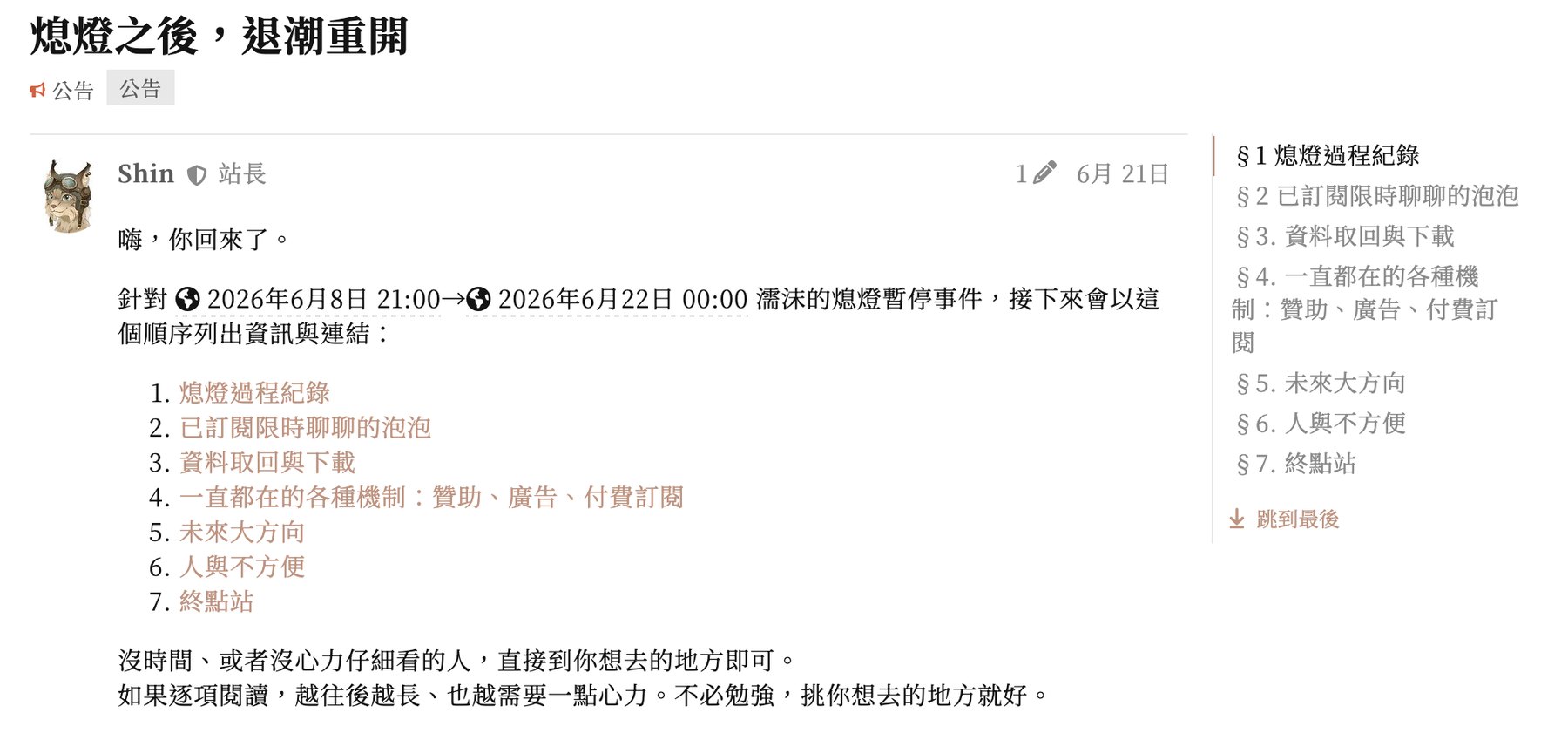
The pause page did not retain its crisis tone. It changed to the past tense. The title became "Lezismore Community / the ebbed-tide scene," and an introduction was added: the tide has receded; this is the muddy intertidal zone. Lezismore's lights are back on. What you are looking at is the archived record of the two weeks with the lights out.
Three kinds of people needed somewhere to land if they visited this page again:
- Those coming for the first time to find out what happened during those two weeks;
- Those returning to read the comments;
- Those who wandered in by mistake and only wanted to use the community;
No fifth layer was added at the deepest point. After finishing the fourth layer, continuing to scroll brought a purple tide rising from below. It covered the screen and lifted you to the surface. On shore there was only a playlist and two sentences: Don't explain. No need to explain.

The original plan for archiving the lights-out pause page was to leave comments open briefly, then close them within a week.
But later, in early July, I changed my mind.
The reason was this: watching the community after reopening, I had expected the thinking and conversations on the pause page to grow on their own inside the community. In reality, after the community reopened, only one post discussed this site's continued existence, governance, or costs — the site's announcement.
The community returned to its quiet, uneventful daily life.
Of the two replies beneath the announcement, one suggested specifying that the currency on the donation page was US dollars. The other was the site's reply saying it had been changed. The community returned to daily life. Those dating went on dating; those submitting posts went on posting.
Perhaps people were shy about showing up to discuss it. What about money, then?
"Money" responded to this incident in the opposite direction from visible discussion. In the eleven months before the lights went out, there were 6 one-time donations in total. During the thirteen days with the lights out, there were 15, including one of US$500. One-time donations spiked while the door was closed and then tapered after reopening; only by August did they approach the pre-pause level. The pattern suggests that visible crisis drew substantially more support than ordinary operation. All the words, money, and support responded most strongly to a "visible crisis." Like the comments, they happened where there was no audience.
Had comments been closed at the end of June as planned, most of those who spoke only on the pause page would probably not have moved into the community to speak. With only 9 more comments over July and August and zero discussion in the community, this page is currently the only place where their writing can be seen.
On the day of reopening there were still 12 comments; 7 more came in the following week; over July and August, only 9. The most recent is dated August 29. In several hundred characters of reflection, the writer describes themselves as "someone who doesn't contribute much in the community. Even leaving a comment here leaves me feeling quite at a loss, but I still want to tell the steward that I read it all."q21
Epilogue
An anonymous infrastructure I had maintained for ten years was paused by my own hand one afternoon. This was not a beautiful fairy tale. On the contrary, it contained many brutal realities that were painful to look at.
Staying alive takes effort. Proving yourself takes effort. Governing takes force. This entire set of governance notes recording the lights-out pause, including when, how, and where it is published, has been thought through and designed. None of it was "just jotted down."
"Being understood by everyone" and "being liked by lesbians" have never figured in Lezismore's considerations.
Back to the title. This circuit breaker trip revealed three things. First, the rhythm of visits did not change, but voices appeared only where there was no audience: visitor numbers during the closure week were the same as before and after, 700 comments went into a private inbox, and the reopening announcement received 150 hearts and zero discussion. Second, the few who spoke wanted mutually exclusive things: stricter rules, no change, real names, anonymity. Any decision would disappoint several other groups. Third, money responded most strongly to crisis: 15 one-time donations arrived during the thirteen-day pause, followed by a gradual taper after reopening toward the pre-pause baseline.
Digging deeper leaves more questions unfinished:
- When maintaining an anonymous community exposed to high risk, can the person governing it be protected by their own design? Or under what circumstances will it turn against them?
- When someone speaks from different positions — victim, user, consumer — how does the responsibility for governance shift?
- Must the distinction between "I" and "we" be imagined only through the two extremes of "personal branding" and "collective governance / decisions by vote"?
- Should "users" feel the responsibility and pressure of maintaining a community at all?
- This incident does reveal some of the difficulties and choices of an anonymous, independent community exposed to high risk. But which principles, cases, and mechanisms can inform other settings?
- Is frictionless, endlessly addictive design really the only approach to community platforms and products that can be treated as sacred law?
- Does being unable to monetize traffic equal failure?
Notes
1 Star, S. L. (1999). The ethnography of infrastructure. American Behavioral Scientist, 43(3), 377–391. https://doi.org/10.1177/00027649921955326 . This article sets out nine properties of infrastructure. One is that it "becomes visible upon breakdown": water pipes, electricity, networks — ordinarily no one looks at them; only when they stop does the work behind them become visible. The same proposition appears earlier in Star, S. L., & Ruhleder, K. (1996). Steps toward an ecology of infrastructure. Information Systems Research, 7(1), 111–134. ↩
2 Schneider, N. (2024). Governable spaces: Democratic design for online life. University of California Press. https://doi.org/10.1525/luminos.181 . The book proposes "implicit feudalism": from forum software to social platforms, the default governance structures of online communities make a sole administrator the sovereign, with no institutionalized participation or checks and balances for members. This is not something someone deliberately chose. It is what the tools default to. ↩
3 Gillespie, T. (2018). Custodians of the internet: Platforms, content moderation, and the hidden decisions that shape social media. Yale University Press. The book argues that content moderation is a platform's core work rather than a peripheral chore, and that at scale it becomes a problem of logistics: rules, staffing, and contextual judgment turn into operations, and every approach fails somewhere. ↩
Quoted comments in full
De-identified full text of every comment quoted above, numbered in order of citation.
q1 The Entryway・June 12 07:45
I thought it was my own browser glitching, deleted it and reopened it, and found it still wouldn't load; then I figured maybe the site engineers hadn't noticed yet, and since I knew the people maintaining the community were doing it unpaid, I was willing to wait it out quietly; a while later, this page popped up, and I found myself wondering whether I'd said something wrong at some point — maybe my account had just been banned 🥲
(later part omitted: mentions rumours about others) ↩
q2 The Entryway・June 10 10:26
I found out Lezismore was gone because I came to reply to a DM.
At first I thought it was a bad signal.
But a few days later I realized the site seemed to have been shut down.
What a shame — this site let people from all over the world get to know each other,
let each other know what they each needed,
and helped ease emotions and stress too.
I hope Lezismore can stay open. ↩
q3 Ebb Tide・June 21 19:11
Getting older, I especially love the feeling of browsing old-style websites, whether it's the layer-by-layer descent or the PS, I love it all 👍
Thanks for all the hard work. I noticed the site was down right away, kept refreshing for several days before realizing it really wasn't opening. Honestly, when I'm lonely, going online to read everyone's posts gives me this comforted feeling of "the world isn't just me being this lonely," and lately having nowhere to go late at night has left me a bit unsettled.
I really like that this place has all kinds of humanities, desire, worries, heartbreak, wanting to fall in love, etc. — a different kind of trouble and format from the usual SNS (after all there aren't many places left where you can properly write long posts)
I really love Lezismore, I'll be looking forward to it coming back! ↩
q4 The Entryway・June 13 07:07
Answering question five.
'Stability' really depends on what the individual needs.
What I'm looking for isn't the kind of place out there for finding any and every form of relationship — for me, what makes this place different from other platforms is a kind of mental stillness, a settling of the mind.
How to put it...
Other platforms are all fast food joints, every step rushed, like you're in a hurry to get something; Lezismore here is more like a coffee shop — I can sit down and rest, just order a hot coffee, read a book, and I can still get something out of it too, whether that's inspiration from the book, someone else's story overheard in the coffee shop, or an offhand warm remark from the staff handing over my order. ↩
q5 The Last・June 19 22:07
Too busy with overtime, only got to properly finish reading it today on my day off. After finishing, the answer really is different — I didn't expect there to be a legal issue involved.
Lezismore disappearing actually feels pretty empty, never thought Lezismore would vanish.
I don't know why, but using this platform never felt like pressure — maybe because it's not that commercialized, you can freely show yourself. On other dating apps, swiping left and right gets you filtered fast, so you have to package yourself up, like putting yourself up for sale on a shelf — someone glances at you once and has to decide whether to put you in their cart, it's missing warmth. Lezismore's post format is more comfortable, more relaxed.
Working overtime till midnight with no one to talk to, checking Lezismore after work is mainly wanting to find some company, add a little flavor to life — some of the posts are pretty good too.
Showing your face or not is up to you, I don't think it matters, just like this platform, it can hold a lot of ideas, a lot of people with different gender identities.
I found out on my own that I couldn't log into the Lezismore community.
Honestly I never noticed the sponsorship thing before, I only really started using Lezismore properly this year. Going forward I'll at least sponsor it like a monthly subscription — to me, users paying for what they use makes sense. Hope Lezismore can keep existing! My life right now is nothing but endless overtime, eating, and sleeping — coming here to browse every day is the only thing keeping me from feeling like my boring, exhausted life is just tragic. ↩
q6 The Last・June 14 17:47
I can only say Lezismore feels really different from other apps — no pressure to perform, you can lurk or speak your mind freely, no algorithm, no need to curate a persona. I never knew how to put this feeling into words, but seeing what the steward said — it's just very human!
Seeing infinite possibility here is what let me feel like there's a free place in this world, unlike other apps where you have to manage your image and get fed algorithmic content just to keep you scrolling.
If a subscription model could be introduced, I think that'd work too — I hope this place can go on being free. ↩
q7 Ebb Tide・June 19 12:49
Is the core goal of this whole layered series of gates to guide the bubbles into thinking about other people's thinking? That's a mouthful.
Once thinking gets activated and there's no clear-cut answer, it produces a desire to connect — screenshotting, telling friends, asking questions on forums, and so on — making the reach of the event grow exponentially. This is basically a social experiment, and I'm genuinely curious whether it'll succeed.
Reading through some of the comments confirms this place really does carry a lot of people's expectations and hopes. I hope the twenty thousand visitors who actively paid attention to this lights-out event (myself included, of course) start using Lezismore more consciously. I believe this small change is enough for Lezismore to grow into the "slightly better" shape that most people hope for. ↩
q8 The Entryway・June 10 01:28
Reading this, my first feeling was that running a niche community must be difficult, and costly. But the tone of some of the questions felt a little like it was putting the responsibility of "do you value this space" back onto the users — that carries some pressure.
If you could explain more directly what difficulties you're facing and what kind of support you need, that might draw people closer than reflective questions do.
The interface is beautiful and comfortable to use. Thank you for the hard work. ↩
q9 The Entryway・June 11 16:32
Found out myself around last week. A place that's 'always there' can never actually be the default — it can only exist because someone nurtures it, someone cares, someone takes it seriously and holds it close. Even a park needs someone to look after and maintain it to keep going, let alone a community. Showing up every day is hard; using real names makes people crave anonymity, and anonymity breeds doing whatever you want without restraint. ↩
q10 The Entryway・June 12 07:33
Eight.
The hardest thing isn't clinging to each other to survive, isn't drifting apart to forget each other, free in the rivers and lakes,
and it's certainly not clinging to each other to survive on the premise that we'll eventually forget each other, free in the rivers and lakes.
The hardest thing is still being willing to cling to each other to survive, even with no countdown in sight to when we'll forget each other. ↩
q11 The Entryway・June 10 06:08
4. The money collected here is embarrassingly little. Do you think that's naive, saintly, not knowing how to make money — or not being allowed to?
Honestly, that's your choice. At most I'd call it "very saintly."
From the very start, watching how you closed my account, and then later how various people kept posting screenshots of conversations without ever getting their accounts closed — honestly, I don't agree with how you run this like a one-man show. Maybe it just happened that whoever stood me up was your admin or someone connected to you — you closed my account super efficiently. I even opened a second account and you killed that one instantly too. But later, when I existed under a different name, a different persona, and ran into a lunatic spreading stuff on here, you let them do whatever evil they wanted in the name of "freedom of speech." Your scales are broken, aren't they? But fine, it's your house, you get the final say.
You've always opened things when you felt like it and closed things when you felt like it.
Now that you're unhappy and want to close it, you come ask us these questions — what are you trying to get out of it? Gratitude? Or just to feel good about yourselves?
Do you actually want to help, or do you just want to feel good about yourselves?
Having a real name would be better — only then could people who do evil actually be brought to justice under the law. I genuinely recommend it. This place is full of all kinds of illegal behavior and threats — whether you truly don't know, or what, I can't tell. And what your original intention even is, nobody can make out.
As for the money — you say you're closing it just like that, so do the ones of us who paid look like idiots, or will you be refunding us on a per-day basis? ↩
q12 The Entryway・June 16 05:42
I've been using this platform for a long time and I think the mechanism here is good. From the opening, I could tell it was heading toward charging for use, and I think that's reasonable — I'd be willing to pay to keep using it. But the way it's phrased feels like emotional manipulation. In plain language, it's basically: 'you've used it free for so many years, running this has been really hard for us, so it's reasonable to charge you now.' I'd suggest phrasing it differently — points one, two, and three really feel like being interrogated. Good communication shouldn't use questions to convey your philosophy. Hang in there, I hope it comes back soon — I'll be the first to sign up as a paid member. ↩
q13 The Entryway・June 14 14:30
If I feel something's worth it, I'll give — whether material or not. I lurked on Lezismore for a long time, watching, and it never became something I was willing to give to. So, that's that. ↩
q14 The Last・June 19 07:36
A lot of people have put the focus of this incident on the legal issue, but I think what's actually worth discussing is the way of communicating, and how the platform positions itself.
First, not being able to disclose the details publicly, and choosing how to explain things, are two different matters.
I can understand that some things can't be made public due to legal or other factors, but that doesn't mean the only option is to hand users a questionnaire and let them piece together what happened on their own.
Even with parts that can't be explained, the platform could still clearly tell everyone: "Some things currently can't be made public, but this doesn't affect your rights of use." This approach might not answer every question, but at least it's direct communication.
So the problem isn't whether there's content that can't be said — it's what approach the platform chooses in facing its users.
---
Second, I think what this incident reflects isn't difficulty running the platform, but a contradiction in role positioning.
This forum has long interacted with users in the manner of a community, often using "we" to describe the relationship between the platform and its users. This kind of approach naturally builds an expectation of shared participation.
However, in this incident, what the steward emphasized was "I'm the one who decides and bears the consequences."
That statement isn't wrong in itself. The platform always had final decision-making power — the real problem is the gap between that and the community image it had shaped in the past.
If what's usually emphasized is community, then when a major change happens, what users expect isn't just the outcome, but usually a more complete explanation and communication.
So the core of the dispute isn't whether the steward has the right to decide, but whether the platform wants to be understood as a community, or as a space led by one individual.
---
Third, I don't think the metaphor of "open dictatorship" fully explains the current situation.
The steward used the example of a company to explain: since it's them who bears the responsibility, the final decision-making power should also rest in their hands; if you can't accept that, leaving is also an option.
But a company and a community are ultimately different.
A company involves an employment relationship, a salary relationship, and a clear structure of power and responsibility, so it's reasonable for the manager to hold more decision-making power.
Forum users, however, aren't employees, and haven't formed this kind of contractual relationship with the platform.
So applying corporate management logic directly to a community platform makes the metaphor feel not entirely valid.
Users may not object to the steward making the decisions, but they may not be able to fully accept understanding the community relationship through a corporate management framework.
---
Fourth, I have reservations about how responsibility is being described.
The steward mentioned: "Whether this community comes back, how long it can last — part of that is now in your hands too, and now you know it."
I understand what's behind this statement is hoping everyone will care together about the platform's future.
But from another angle, the platform running into difficulty doesn't, on its own, automatically create some kind of obligation for users.
If the platform needs support, it could actually propose a more direct, concrete plan — a membership system, a subscription model, crowdfunding, or some other workable model.
That way, people willing to support it could choose to support it, and people unwilling could freely decide too.
By comparison, if on one hand it's mentioned that the platform's future is tied to the users, but on the other hand there's no clear statement of how you'd want everyone to participate, it's hard to avoid some people feeling like responsibility is being shifted onto them.
---
Fifth, the comments section actually shows another phenomenon.
Looking at the large number of comments, many users actually haven't taken the platform's existence for granted.
On the contrary, quite a few people have proactively proposed possible options like paying, subscriptions, ads, or a membership system.
This shows that many users actually understand that running a platform costs something, and are willing to discuss the practical issues.
And among all the many opinions, the most consistent request is actually the hope of being able to back up one's own posts.
This need doesn't involve complicated legal issues, nor is it a particularly radical demand, so many people would expect the platform to give a clearer response on this.
---
So my view is actually simple.
The fact that this incident didn't turn into a bigger conflict doesn't necessarily mean every approach taken was fine.
The more likely reason is that this community isn't large in scale, and many people have accumulated long-term emotional attachment and identification with it, so they're willing to extend a higher degree of understanding and tolerance.
But if the same thing happened on a bigger platform, the focus of discussion probably wouldn't be legal details, but two more fundamental questions:
Is the platform really a community, or a personal website?
And, where exactly should the line of responsibility between the platform and its users be drawn? ↩
q15 The Abyss・June 19 09:00 (the commenter describes this as produced with AI assistance)
I just saw someone at the end of the second layer write:
First, not being able to disclose details publicly, and choosing how to explain things, are two different matters. Second, I think what this incident reflects isn't difficulty running the platform, but a contradiction in role positioning. Third, I don't think the metaphor of "open dictatorship" fully explains the current situation. Fourth, I have reservations about how responsibility is being described.
I threw it at an AI and asked it to analyze it from a third-person perspective:
Let me say this first: this comment is written more carefully than most comments. It actually read things, organized its thoughts, and didn't stop at "is it a money problem" or "why not just say it directly." The tension it caught — a place that normally says "we," but at the critical moment says "I'm the one who decides" — is real, it's not something she imagined. That needs to be said clearly up front, because what comes next isn't "she's wrong."
But there's one thing this comment never noticed from start to finish: the whole thing is measuring a place that isn't a normal platform, using the ruler for a "normal platform."
The words she uses — crisis communication, role positioning, boundary of responsibility, the company-versus-community comparison — all come from a very mature framework for discussing "how should a platform face its users." That framework is very useful, and in most cases it's also correct. The problem is, it assumes the thing being discussed is a "normal platform": one with a team, a public-facing point of contact, a crisis-response process that treats "putting users at ease" as the top priority.
Lezismore isn't that kind of thing.
So when she measures it with that ruler, every "shortfall" it turns up — some are real shortfalls, some are just "this ruler can't measure this shape." What's worth the effort is separating the two.
Her first cut is actually the sharpest: not being able to disclose details, and choosing how to explain, are two different things; even with parts that can't be disclosed, you could still just say directly "some things can't be made public, but it doesn't affect your ability to use this," instead of throwing out a questionnaire and letting users piece it together themselves.
This cut, the site can't dodge.
It's true — some people will feel this round's questionnaire was too roundabout, not direct enough, hiding what needed to be said inside layer after layer for people to dig out themselves. That feeling is reasonable, and it won't disappear just because "actually this was deliberately designed this way" — for someone who just wants to know what happened as fast as possible, "deliberately designed to make you walk through it slowly" and "just not explaining properly" feel the same in the body. If someone feels neglected because of this, that's the cost this approach was always going to have to pay — it's not a misunderstanding.
But sharp as this cut is, it assumes one thing: that the purpose of an explanation is to make people feel at ease as quickly as possible.
If that really is the only purpose, then she's 100% right, and explaining directly is the most efficient. But this questionnaire clearly was betting on something else — it would rather be slow, would rather have some people complain it's roundabout, as long as the person walking through it gets to see how others think first, first bump into the answer that pops into their own head right away, and then discover that answer isn't quite enough.
This is a different view of what "explaining" is for: not feeding you the conclusion, but letting you grow it yourself.
These two views of explaining can be argued over, and they're worth arguing over. But what should be argued is "which one is better," not "why didn't the site do the first one" — because the site isn't incapable of the first one, it chose the second one. Calling a "choice" a "shortcoming" is exactly where the ruler is measuring wrong.
Next is what she finds least defensible: "open dictatorship" and the company analogy.
The part where she's right really is right: users aren't employees, they don't get paid, they're not bound into an organizational structure of power and responsibility. Using a company as an analogy really does miss that piece. Her asking others not to think about community through the obedience logic of an employment relationship is fair.
But while opposing the company analogy, she also quietly slips in another analogy of her own — putting users back into the position of "external consumer." Someone who shows up, uses it, leaves if unhappy, and the platform is obligated to serve them well.
That analogy isn't accurate either.
Because in an anonymous community, users aren't external at all. How she posts every day, how she responds to a post she doesn't like, how she flags something, how she handles being unhappy, whether she holds off on judgment when she sees chaos — all of this is shaping what this place becomes.
So the real shape doesn't fit either analogy.
It's an asymmetric relationship: the most fundamental things — legal exposure, cash flow, operations, risk of penalty — fall on the site's shoulders; but the day-to-day culture, the atmosphere, whether this place is worth staying in, is something everyone grows together. The foundational responsibility is asymmetric, but the everyday responsibility is shared. This kind of thing — the company analogy is too heavy, the consumer analogy is too light.
Her alertness about "responsibility being shifted" should also be looked at from here.
The site said, "whether this place can keep going is partly in your hands now." If this sentence gets read as "so you all need to pay," then her discomfort is completely reasonable — the platform being short on money doesn't automatically create an obligation for users to pay; if money is needed, the plan should be spelled out clearly so willing people can choose. That's right.
But this sentence could also point to something else, something harder to deal with: whether a place can keep going often has nothing to do with money at all.
It's whether, when a personal dispute comes up, someone dumps the whole pressure onto the site. It's whether, seeing someone they don't like, someone wants to use the rules to drive that person out. It's whether, when penalized, someone uses screenshots and mobilization to force the site to respond publicly. It's whether, when someone wants to help, that good intention ends up becoming new trouble instead.
None of these can be solved by any membership system or fundraising plan.
If "responsibility" is only understood as money, then this harder layer gets skipped over. It's not consumer responsibility. It's more like: you live here too, and how you live here has something to do with what this place looks like.
The two facts she raises are also worth separating.
She says a lot of people proactively suggested paying, subscriptions, ads, membership systems — proving users don't take this place for granted. That's correct. That users are willing to discuss the reality should be recognized.
But here's something she never noticed the whole way through: the things she's presenting as "suggestions" — paid subscriptions, sponsorship, ads — already exist. She's not making a proposal, she's describing a status quo she hasn't noticed.
And this is where it really stings — and it doesn't just sting her.
If these things have been there all along, then the answer to "why don't a lot of people know" probably isn't a pleasant one: because before this happened, how many people actually came to look, to ask, to think about how this place operates, what it runs on, what options exist?
Taking a place that not many people normally pay serious attention to, treating it as "it was always going to be here, it was always supposed to serve me well," and then, the moment it runs into trouble, going back and checking it against a set of platform-governance standards to see where it fell short — that imbalance is more worth pausing on than "the site didn't communicate enough."
Saying "the site didn't make this clear enough, or often enough" is a fair criticism.
But it's tied to another question: between a place that deliberately doesn't blast out notifications, doesn't push its presence through mainstream social media, and us, who are used to being chased by push notifications and treat something as nonexistent if we're not reminded of it — who really failed to get the message through, and who had already stopped actively looking?
Unless these two questions are separated, "why didn't I know" will just stay stuck complaining about the site, and never reach the harder half.
As for the most consistent request — backing up one's own posts — that need is real and shouldn't be brushed past lightly. But it's also not as simple as one sentence, "open it up for download" — anonymity, deleted posts, drift-bottle posts, other people's information caught inside comments, private clues buried in old posts, all of it is tangled together.
It needs to be designed slowly, not rushed out in a panic.
Coming back around, to her final two questions: is this a community or a personal website? Where should the line of responsibility be drawn?
These are both good questions — good enough that they deserve not to be trapped by their own either/or framing.
Lezismore was probably never either a community or a personal website. It's an ecosystem where the site carries the underlying risk, where a lot of people grow the culture together, and that has to carefully navigate between anonymity and real-world risk.
In a place like this, users have influence, but they're not co-operators.
The site has decision-making power, but it's not an all-powerful caretaker.
The community can be used, but that's not the same as a commercial service.
The community can be participated in, but it's not a wishing well.
Whether people can accept this awkward, unmeasurable relationship stuck between categories — that might be the real question this incident leaves behind.
And that question won't be answered on the second layer.
———
Why does it feel like my AI is different from other people's — is it because I've talked about Lezismore too much? ↩
q16 Ebb Tide・June 19 15:58
My thought is,
if possible, please set up a large management team.
Members of this management team would need to pass an interview with the admin first.
Hold regular meetings to review and establish a full set of SOPs for reviewing and managing this community.
There's a big Facebook group about hotels, and also a round-island cycling group, that have absolute zero tolerance for members who repeatedly cross the group's bottom lines (the moment they hit a keyword the admins set up, that's it) — even if the person keeps coming back with alt accounts, they'll get caught and sent packing with a one-way ticket, no exceptions, in order to protect the rights of the group's many members.
This land that is Lezismore has fertile soil — seeds blown in on the wind sprout and grow wherever they like. If there's only one gardener doing the pruning, the exhausting result of running yourself ragged will just keep piling exhaustion on exhaustion. ↩
q17 Ebb Tide・June 19 22:56
I just want to be a low-key user who makes small donations.
Hope Lezismore stays as it is — I feel I can use it with fewer inhibitions this way. If it wants to grow bigger, it'll need to commercialize to be easier to manage. ↩
q18 The Abyss・June 18 17:35
I feel like the steward has been driving a train — the original intention was probably hoping everyone on board could set aside worldly judgment and social masks, and communicate and connect together. Everyone boards for different reasons — some to exchange ideas, some to lurk, some to share their creations, some looking for desire — people getting on and off, coming and going. But in this process, the pressure the steward has been carrying is beyond what we can imagine — news stories, worldly judgment, legal statutes, hardware and funding — every time something happened it was like another layer of fog in front of the train, and when the fog got thick enough, you'd want to stop and check whether the way ahead was safe.
Every time the train stops at a station, it's a big deal for the steward. I haven't been on Lezismore for long, but seeing the steward keep updating the comments this time, I could really tell 😂
The steward cares a lot about this space and values us passengers a lot, hoping we can feel at ease and happy in this space. Through this stop, I've learned that not every place lasts forever, and maybe this train will disappear someday too. But like the steward said, the most important thing about this space is "people." Selfishly, I hope the train keeps running too, and I want to bet on a future with the steward, but no one can guarantee what the future holds.
Lastly, I want to say thank you to the steward and everyone who has guarded this space. Thank you for having carried all of us — no matter where this train ends up stopping in the future, I want to thank you for the companionship during this time. I hope that once that thick fog clears, you'll find the way of driving that feels most comfortable to you. ↩
q19 Ebb Tide・June 22 16:35
Didn't expect that it's already reopened and I can still leave comments (covers face
Seeing the admin peel back layer after layer to get to the real, heartfelt words underneath, I couldn't help but want to self-disclose a little too, in response.
I was once a PTT Lala-board moderator for a short while, and I really understand how running a community, or even just keeping a board going, is itself extremely draining. Every single post, every day, has to be read start to finish, and there's always someone posting without having read the board rules — but that's still a small thing. What really burns your brain is dealing with flame wars. Usually there's no such thing as a real villain in them, but with emotions running high and everyone digging into their own position, it's hard to untangle, and sometimes you still have to use administrative power to lock a thread or put someone in the penalty box.
So I truly admire the admin's long-term upkeep of this place. For the sake of physical and mental health, maybe worth considering finding people to take shifts, or taking some time off — like closing two days a month with no need to moderate posts? (throwing out random ideas)
It's also through this deep dive and reflection that I went back to check on the Lala board again. Even though I haven't posted or commented there in a long time, it's still an old home.
So is Lezismore.
Wishing every community friend reading this happiness. ↩
q20 Ebb Tide・June 19 09:55
I bet most people lean toward using the word "laughing to death" (笑死), or even the evolved version "laughing rat" (笑鼠) — anyway I personally love using this term! Doesn't make you sound old at all. To me, "laughing to death" is more of a dismissive, joking attitude, while "so funny" is just a plain, ordinary kind of feeling.
"...want to go deeper?" is admittedly a little suggestive, but with the site discussing things this seriously this time, I really can't bring myself to think about it in a not-so-serious direction (give me my tears back!
Getting to the Ebb Tide, I'm curious what kind of response the site actually wants to see?
My understanding is, the site doesn't want us to only offer "spiritual" or "monetary" support, so that's why I've been thinking about what actual actions we should take to help Lezismore, even offline, level up further.
But after reading through the comments here, it seems like no one / only a few people are thinking as far ahead as I am (are they?
P.S. I won't be taking screenshots anymore — after seeing the group's reactions, it's honestly pretty disheartening. ↩
q21 Ebb Tide・August 29 22:47
I've actually always been someone who doesn't contribute much in the community. Even leaving a comment here leaves me feeling quite at a loss, but I still want to tell the steward that I read it all.
In the five years since I made an account, reading the discussions here has always made me feel safe, and I've learned and grown from them. The feeling this place gives me is like being able to sleep deeply beside someone I love. I'm not arriving at a noisy gathering. I don't need to come here to do anything in particular. I can interact in whatever way feels comfortable to me, even if that means lurking. So to me, this is a very rich place, where anything might happen, and I read a little of everything, a little at a time.
And I also have to admit my own naivety. I feel I've grown here into someone who couldn't really be called a good person, but who at least tries as hard as possible not to hurt others, and I just assumed everyone was the same. Even with a pace that already feels very slow to me and so many layers of filtering, painful things can still happen. Thank you again to the steward for being willing to share the truth about this safe harbor with us, and how you've felt along the way. ↩
q22 The Last・June 20 11:40
A lot of people naturally end up feeling that everything's existence is just "a given," even though a moment's thought shows that nothing really is.
I'm a trans lesbian — lesbians who can accept someone with male physiology are still a minority, and I'm also not at the age that's in demand, so I often feel like what happens on this site has nothing to do with me. After scrolling for a while I lose the motivation to keep coming back. Still, I hope this community site can keep existing. ↩
2026年6月中旬,濡沫熄燈兩週的治理筆記
2026年6月9日,那一天,濡沫社群突然關閉,沒有公告或說明。這是一個每月有三到九萬不重複訪客、完全不經營Meta或其他主流社群媒體的自架社群。
作為性少數、性積極、匿名、獨立自架的社群,這當然不是第一次遭逢關閉或意外。從2015年開始,我們就是「被女同志圈驅逐」而誕生的。然而這一次,不是因為被主流平台封禁,也不是因為主機商關閉,也不是因為外界重大事件影響而暫停;而是十多年來第一次,由「站方」自行手動停下。
沒有伺服器故障,沒有外界重大事件,沒有技術問題。
這次事件背後真實的原因,若要用比較安全的說法來描述,會是:基礎建設的斷路器過載。
整個熄燈暫停事件歷經十三天後,社群重開。暫停期間,社群入口換成一張暫停頁。
一開始只有第一頁的八個問題。沒有任何「品牌」或「社群」常見的解釋說明。
過幾天後,頁面越長越深、越多層,每一層往下,都有更多新的資訊與新的留言。
這個「暫停頁」截止寫這篇的時間點,已陸續收到七百則匿名留言。
書寫這篇的人是站長(我)。七百則留言,我每一則都用人工、肉眼讀過,接下來的引用,也是我挑的。挑的原則是:每一層都有,最兇的與最深的都在,每一則附全文,讀者可以自己判斷有沒有斷章取義。
大家當時在暫停頁留言框框上看到的是:匿名留言不保證刊出,部分可能作為治理素材公開。匿名留言沒有索取或搜集個人資訊,刊出前也都有經過人工基礎去識別化。(例如提及ID帳號、地理位置等等個人資訊,均已去識別化處理。留言內容提及「請不要刊登」者,則沒有刊出。)
一、停:斷路器跳掉,基礎設施才被看見
我使用「斷路器過載」來形容熄燈暫停的動作,因為這是從「站方」角度出發的。
社群泡泡感受到的層面,是:無法進入平常的社群,僅有一頁暫停頁與八個問題,主站還留著。站方沒有預告,詢問身邊朋友,有零星猜測,但沒人知道真正的原因。濡沫確實有數個主流社群平台帳號(例如:FB粉專、IG、Threads、X等等),但已經停止更新多年,有的甚至空無一物。
熄燈之後,最初的14小時,從站外來問的有3個人。泡泡透過慣用的LINE、Instagram,詢問:網站是不是壞了?
一個每月不重複訪客三到九萬的網站,停機14個小時,卻只有3個人主動來問——這個數字在流量經濟的時代,很容易被解讀成一個傷人的答案:「紅不起來、沒人在乎」。
不過,完全不經營主流社群媒體,不「日更」、不「刷存在感」,極力避免宣傳個人品牌,是濡沫多年來的日常。這種情況下,「停機後主動來問」存在極高的摩擦:要問一句話,得先離開網站,自己找到別的管道,然後打擾一個不確定態度和狀況如何的人。
同時,也因為濡沫用了很多年,把「不催促、不打擾」做成社群文化與體質的一部分,因此,泡泡本身的反應,也呈現出這個空間帶給他們的東西。從後續的部分留言,也可以證明:
我以為是自己的瀏覽器故障,刪除了又重新開啟,發現依然無法載入;再後來覺得或許是網站工程師還沒發現,也因為知道維護社群的夥伴是無償付出,所以願意靜候等待;又過一陣子,跳出這個頁面。
玄關・6月12日 07:45 留1
發現濡沫不見是因為上來回私訊,一開始以為是訊號不好,但過的幾天才發現好像是關掉網站。
玄關・6月10日 10:26 留2
第一時間就發現網站死掉,連刷了好幾天才發現真的打不開。
退潮・6月21日 19:11 留3
幾小時後看 Cloudflare。熄燈第一天,有 3,941 個不重複訪客來到這扇關起來的門。這個數字含機器流量,單看一天說明不了什麼;把熄燈前後三週排在一起,比較才成立:
關站那一週來的人數,跟前一週、重開後一週幾乎一樣。少掉的是請求數,那是社群軟體與機器之間的自動對話。人的到訪路徑沒有因為門關了而改變。這組數字回答不了「在不在乎」,它回答的是依賴:這個地方織進了多少人的日常。
從泡泡的角度來看,平常打開濡沫,通常是留在「社群」裡面,完全不會想起「主站」,因為與大部分人的交友需求沒有直接性的關聯。隨意逛逛、滑滑,交友、約會、書寫創作,普通的日常,甚至更多人什麼都不說,只是潛水閱覽。在這裡,沒有追求點讚、曝光的文化,也沒有追蹤個人品牌的習慣,就只是單純的「生活」。
其他平台都是速食店,每個步驟都在趕,像是急著得到些什麼;濡沫這裡像是咖啡店,我可以坐著休息,只要點杯熱咖啡,看看書,我也是能得到些什麼,不管是書本上的啟發,咖啡店聽到的別人的故事,抑或是店員遞上餐點時隨口一句暖心的話。
玄關・6月13日 07:07 留4
使用這個平台沒有壓力不知道為什麼,可能沒那麼商業化,可以自在的展現自己,其他交友app左滑右滑快速被篩選所以要包裝自己,好像把自己上架販售,對方看一眼就得選擇要不要放入購物車,少了溫度。
最後・6月19日 22:07 留5
沒有演算法不需要社群經營……不像其他app需要經營人設,還會推演算給妳只因要妳繼續用下去。
最後・6月14日 17:47 留6
正因為如此,社群泡泡完全不需要知道今天誰會處理檢舉、備份有沒有跑、某個功能背後碰到什麼法律問題?或者一個看起來很小的修改,最後要由誰去判斷。因為這本來就是「基礎設施」的工作:能正常使用的時候,它最好的存在方式,就是安靜到讓人忘記它其實存在。
一座運作超過十年的基礎設施,維持得越久、越不爭奪可見度與話語權,「明天還會打得開」就越來越像理所當然……;直到有一天,它真的關上了。
Susan Leigh Star 說,基礎設施只有在壞掉的時候才變得可見。1
從站方的角度來看,斷路器跳停,需要休息。連回覆的一絲一毫力氣都沒有。但如果解釋,又會落入不必要的自我揭露與社群審查:社群不會意識到怎麼做的、歷史、代價,只會感覺到不方便。解釋本身就需要力氣,也帶來風險。解釋越多,等於越把審判「你夠不夠格」的權利交給群眾。
另一方面,如果趁大家正在重新注意這個基礎設施的時候,急著把十年來的辛苦一次攤開講完,又會造成不同的困境:長篇大論,誰要看?截圖、轉傳、斷章取義,都還是其次。最麻煩的,是整個解釋變成另一種情緒債務:彷彿在要求一群「只是來用用」、「從來沒有答應要承擔這些事」的人,在那個時刻必須心疼、必須理解、非得給出正確答案。
但如果什麼都不說,之後直接重開,整個事件充其量不過是一場停機。
該怎麼做呢?那時候,暫停頁最早只有一句狀態,和八個問題。其中三題:
一個地方「一直都在」,你覺得是預設值,還是成本?
暫停頁第一版・6月9日
這裡收的錢少到不像話。你覺得是不會賺,還是不能賺?
如果開這個地方的人有名有姓、有臉、天天現身跟大家搏感情,你在這裡,還會像現在這樣說話嗎?
沒有標準答案,只有單純的留言框。匿名留言傳入後端,沒有個人資訊。最一開始也沒有把留言公布在牆上,所以更沒有其他人按讚、爭論,或比較哪一種說法比較高級、比較正確。
「一個地方『一直都在』,是預設值,還是成本?」
針對這題,明確回答的 50 則裡,七成答「成本」,一成六答「預設值」,另有幾則說「對使用者是預設值,對維護的人是成本」。答案不算分散,分歧在於站在誰的位置看。
二、問:把摩擦做成設計
暫停頁有四層,這個結構並不是「一開始就想好」的,而是在長達兩週的暫停期間,一邊觀察社群的回應,一邊同步決策、開發製作出來的。
第一層的八個問題稍早你已經看到截圖,最下方只有一個留言框,回答沒有保證公開,看不到別人留什麼,沒有觀眾,沒有按讚競賽,沒有為了旁觀者寫的留言,沒有立刻被截圖的即時風險。
社群長期以來,其實知道網站背後有「人」在管理,因此留言的預期是「會被某個管理者看到」。匿名留言同時卸除了身份或表演的包袱;不即時公開,寫的人也不需要對著觀眾表演。這樣設計,是希望收到的話會更無負擔、更真實且直接。成效如何?往後你看到其他的留言內容,應該可以自行判斷。
熄燈暫停頁留言機制的設計,留言送出時不隨附、也不儲存 IP,頁面不裝第三方分析與字型、不存草稿,收件進一個與社群系統隔開的私有資料庫(主機商在網路層看得到的連線紀錄,就是前文那組訪客數的來源)。收到後由站長人眼看過每一篇,處理去識別化,辨別留言內容。
接著,頁面開始往深處長:第二層、第三層、第四層。
第一層:「玄關」:一句狀態、八個問題、一個留言框。
第二層:「最後」:有語音和圖片、文字的幾個房間,簡述濡沫的規則與代價,6月13日上線。
第三層:「深淵」,講法律、邊界,與基礎建設底層位置扛著的東西,6月16日上線。
第四層:「退潮」,6月19日上線,是十多年來第一次用站長的身份、用自己的語氣對社群說這麼多話。
每一層之間,以「停留時間」做區隔,彼此之間沒有任何密碼,也不需要註冊、邀請碼、熟人帶路。例如:讀完第二層的留言區、停留一段時間,一顆暗紅色的心才浮現,那是第三層的入口。走完第三層、再停留 20 秒,一顆墨綠色的芽才出現。入口不寫「更深」「下一層」,只有顏色、光暈與呼吸的節奏。
從第一層到第二層則靠一個潮水動畫:頁面往下捲,水位跟著退,退到最底匯聚成一顆發亮的土黃色泡泡,那顆泡泡就是入口。整個過程,完全反行銷漏斗,沒有一個字或按鈕在做推銷。沒有時間、不想看、懶得看、不屑看,剛好忽略的,就自然而然地忽略了。
我們沒有為了商業目的,強迫、誘拐、引導任何一個人停留。
這個大膽的設計判斷,是把摩擦與閱讀節奏當成產品設計的一部分。當然,摩擦要小心處理,既不能完全沒有,也並非越多越好。第三層到第四層的等待定在 20 秒,比前一道稍長,保留「又更深一層」的感覺,但不能長到打斷心流、令人不耐。應該要是合理的閱讀速度,畢竟能走到第三層底的人已經被層層篩過,再加長閘門只會懲罰最忠實的讀者。
此外,設計上也考慮到閱讀網頁時需要「減少動態效果」的人,潮水動畫退成靜態,但解鎖邏輯保留,他們不會因為關掉動畫就失去入口。使用鍵盤聚焦、按 Enter 進入,都能讀到螢幕閱讀器相容的標籤。
這整套設計,有一小部分被泡泡看穿,也被泡泡質疑。
這一系列層層的關卡最核心目標是為了引導泡泡們思考他人的思考嗎?……根本是一場社會實驗,我很期待成功與否。
退潮・6月19日 12:49 留7
某些提問的語氣,有一點像是在把「是否珍惜這個空間」的責任放回使用者身上,會有些壓力。如果能更直接說明目前遇到的困難、需要什麼支持,可能會比用反思式提問更讓人願意靠近。
玄關・6月10日 01:28 留8
第二則留言的位置,是在最入口的「玄關」,就是面對著那八個問題,而感到壓力的泡泡留言。他的批評剛好呈現出他認為應該被告知什麼、過去不清楚什麼。
不過,他說的對,「反思式提問」比起「客服式公告說明」,確實讓讀者不舒服,這是整個設計知情、並且主動選擇的。畢竟,十多年來,把自己活成基礎設施的代價,就是「使用者無感」。
公開在站上直接講,在多數人沒有準備好的情況下,很容易只看到幾句話就引發情緒或誤解;資訊量太多,就直接讀歪或略過。因此設計做了分層說明,不強迫所有人閱讀。
三、聽:七百則留言能證明什麼,不能證明什麼
整個熄燈暫停頁,像是一條充滿摩擦的崎嶇的路。再加上不在任何主流社群媒體宣傳、互動,這些種種「不利」的前提下,依然有不少泡泡在這裡留下了文字。
首先,這些留言是在一個「持續迭代」的介面上留下的,每一個迭代版本,都影響著後面的泡泡會讀到什麼。舉例來說,第四層一整層包括留言區,是6月19日才上線的,在那之前的人,根本沒有第四層可以來訪。所以整個結構並不是連續的「漏斗」。
此外,讀留言的人是站長,這700則之中,由於完全匿名,沒有任何身份綁定或辨識機制,所以也可能發生同一個人留了多則的情形。因此,這700則留言,只能呈現「熄燈暫停事件」中走到不同位置的泡泡所留下的不同文字。
以下是隨著時間迭代,留言的數量分布:
前面大言不慚的說把摩擦力做成設計,實際上泡泡留言的情況如何?
整個留言分布,可以看到非常「反行銷漏斗」,甚至第四層(最後一層,退潮)的留言數還多過了第三層深淵。字數隨深度變長。玄關近半數不到30字,多半是「謝謝」「辛苦了」「快回來」。第三層與第四層中,超過半數的留言字數超過100字。
有些留言的態度,無法用關鍵字直接判斷,必須做人工判讀。例如「一直都在是預設值還是成本」這題,有人留言:
一直都在的地方永遠不可能是預設值,要有人呵護有人在意有人當一回事放在心上,才有可能存在,就算是公園,也要有人照顧維護才能維持更何況是社群。
玄關・6月11日 16:32 留9
或這則,回答最後一題:
最難的不是相濡以沫、不是相忘以江湖,更不是在相忘以江湖的前提下相濡以沫。最難的是在看不到相忘倒數狀況下,仍然願意相濡以沫。
玄關・6月12日 07:33 留10
逐則讀完之後,每一則標了態度:明確反對站方做法的,與在某條邊界上有異議的。明確異議 9 則,8 則停在玄關。3 則如下:
現在不爽了要關,跑問我們這些問題,你是想得到什麼?感謝?還是感動自己?……有名有姓更好,作惡的人才有辦法依法制裁。
玄關・6月10日 06:08 留11
看這開頭就知道是要開始付費了,覺得合理之後也願意付費使用,但這表達方式感覺是在情勒……一個好的溝通不該用問題來傳達你們的理念,加油吧希望能快點恢復我第一個加入付費會員。
玄關・6月16日 05:42 留12
上到濡沫觀望了很長一段時間,它並沒有成為我願意付出的樣子,那麼,就這樣吧。
玄關・6月14日 14:30 留13
還有一種距離,不是反對,是覺得這裡與自己無關。一位在四層都留了言的泡泡寫:
我是個跨拉,能接受具有男性生理的拉拉畢竟是少數,加上也不是吃香的年紀,常會覺得站上的事好像都跟我沒有關係,滑久了就沒有動力常上來。不過我還是希望這個社群網站能繼續存在下去。
最後・6月20日 11:40 留22
同樣叫性少數,要在同一個空間裡對每一種人都真實,比口號難得多。站方做過的事,對一個沒有在這裡看到自己被持續對話的人來說,等於沒做。
留言的態度不能輕易的二元(支持/反對)區分。例如帶有批評語氣的人,同一句話裡說開站後要第一個付費。在第二層「最後」中,有一則千字批評留14,內容大致可以歸納為五點:1. 不能公開細節與選擇怎麼說明是兩件事;2. 平台長期用「我們」講話、關鍵時刻卻說「決定的是我」,這中間有落差;3. 「開放的獨裁」這個比喻不能完整解釋現況;4. 對責任的描述方式有所保留;5. 從留言區看,多數使用者其實理解營運有成本、也願意談付費,其中最一致的訴求是能備份自己的文章。後續,第三層出現另一則留言,直接把前四點整段丟給 AI 做第三人稱分析,再把數千字的分析貼回第三層留15。
針對社群治理的困境,泡泡們想到的治理方式五花八門,但彼此之間是互斥的。舉例來說,有人要求更嚴格的審查:
如果可以請成立一個大型管理團……定期開會檢討並制定一整套的SOP來審查管理這個社群……對於常觸犯社團底線的成員是絕對的零容忍。
退潮・6月19日 15:58 留16
有人要的是不要變:
我只想做個有小贊助+低調的使用者,希望濡沫保持現況,覺得使用上也比較沒顧忌,如果想要發展更大就要商業化才比較好管理了。
退潮・6月19日 22:56 留17
這個社群從2017年,就決定了管理者不做個人品牌的原則。Nathan Schneider 用「隱性封建」形容網路社群的預設結構2:單一管理者即主權者。而整個熄燈暫停頁,把對話的結構與層次搭建起來,讓泡泡自己決定要不要走到那裡、要走到多深、要不要回應、要怎麼回應。
眾多留言中,有人強烈要求實名制,也有另外一些人表示一旦實名就不會再用;有人要先看方案才決定。每個人對於「更好的濡沫」有各種想像,但這些想像,完全湊不到一起。無論決策往哪一邊走,另外幾群人都會失望。
面對這種張力,濡沫並不陌生:2022 年團隊解散、2024 年「站方不欠誰」,治理原則、資源現實、等等種種困境,在時間軸上早有痕跡。
而在第三層、第四層的深處,泡泡的留言內容明顯與最前面的玄關有很大差異。有人嘗試描述「社群治理者的位置」:
我覺得站長很像在開一台火車……每發生一件事情就好像火車前面多了一層霧,當霧越來越濃的時候,就會想要停下來確認前方是不是安全的。
深淵・6月18日 17:35 留18
有人當過同一種角色:
在下曾經當過一小段時間的PTT拉板板主,深能體會經營社群甚或只是維持版面,本身就極度消耗心力……為了身心健康是可以考慮找人輪班,或者放假一下,譬如每個月公休兩天不用審核文章?
退潮・6月22日 16:35 留19
也有人直接問:
走到退潮,我很好奇站方目的是想要看到什麼樣的回應?我的理解是,站方不要我們只會「精神」、「金錢」支持,所以我才會思考我們實際要去做什麼行動。
退潮・6月19日 09:55 留20
值得留意的是,越深處的留言,並不等於「順從」或「認同」站長的話。相反的,走到底的留言裡出現的是換位思考、經驗共鳴、可能性提案。批評者也沒有因此被「噤聲」,他們的留言留在門口。從留言位置看不出他們讀到哪裡,看得出的是:批評沒有被擋在外面,也沒有被篩掉。
Tarleton Gillespie 指出,大型平台的內容審核,與其說是規則與價值的問題,不如說是後勤與規模的問題3,然而,濡沫面對的問題不單單只是規模大小,而是更極端的風險:內容審核一直是社群治理裡面極難處理的一塊,主流平台的內容審核,多半把性內容放在第一批要移除的名單上。一個以性積極、性少數為主體的社群,它的實踐、治理與困境,因此很少被當成內容審核討論的對象。
在一個多年來刻意拒絕規模化、支持情慾友善、以性少數為主體的地方,13 天裡有三萬多個不重複訪客走到那扇關起來的門前,其中將近七百則留言留了下來。這場思考,是這些留言與留下留言的人一起完成的。
四、收:一場危機怎麼被收回日常
6月22日,社群重開。
重開同時,也發布了一篇公告。公告內容不再解釋為什麼熄燈暫停,只列操作性與知識性的重要資訊:
- 熄燈紀錄封存在哪
- 訂閱怎麼處理
- 資料怎麼取回的方式
- 贊助、廣告、訂閱等等許多人「建議濡沫可以嘗試」的機制,從很多年前就一直存在。
另外,還提到了未來大方向(不會全面實名制),以及人力比錢難(經費並非最困難的部分)的部分。
暫停頁沒有維持危機語氣。它改成過去式,標題變成「濡沫社群/退潮現場」,還加了一段前導引言:潮水退去,這裡是泥濘的潮間帶;濡沫已重新亮起,你現在看到的是熄燈期間兩週的封存紀錄。
三種人如果再訪此頁,都要有落點:
- 第一次來、想知道那兩週發生什麼的;
- 回來看留言的;
- 誤闖只想用社群的;
最深處不再加第五層。讀完第四層繼續往下捲,紫色的潮水從底部漲上來,覆蓋畫面,把人托出水面,岸上只有一份歌單和兩句話:不要解釋。不用解釋。
原本針對熄燈暫停頁的封存計畫,是開放一小段時間後,一週內要關閉留言。
但後來(七月初),改了主意。
原因是:重開後觀察社群動態,本來期待是暫停頁裡那些思考、對話,會在社群裡自動長起來。不過現實是,社群重新打開後,所有文章裡討論到這個站的存續、治理、代價的,只有一篇——站方的公告。
社群又回到了平靜無事的日常。
其中公告下方的兩則回覆,一則是建議捐款頁的幣別加註美元,一則是站方回應說已經改了。社群回到日常,約會的約會,投稿的投稿。
關於現身討論,或許大家是害羞。那麼,錢的部分呢?
「錢」對這次事件的反應跟現身討論的方向相反。熄燈前十一個月,單次贊助共 6 筆;熄燈的十三天,15 筆,其中一筆 500 美元。單次贊助在門關著的時候暴增,重開後逐月遞減,到八月才接近熄燈前的水準。看得見的危機,換來的支持遠多於平常的日常營運。所有的話語、金錢、支持,對看得見的危機反應最強;跟留言一樣,發生在沒有觀眾的地方。
如果照計畫在六月底把留言關掉,那群只在暫停頁開口的人,多半不會改到社群裡發言。從七、八月只多 9 則、社群裡零討論來看,這個頁面是目前唯一看得到他們寫字的地方。
重開當天還有 12 則,接下來一週 7 則,七、八月兩個月只多了 9 則。目前最近一則留言是8月29日,數百字的感想中,說自己是「在社群上不怎麼有產出的人,就連要在這邊留言也覺得很不知所措,但還是希望告訴站主,我有看完」留21。
尾聲
維護了十年的匿名基礎設施,在某個下午被自己按了暫停。整個事件,並不是美好的童話故事,相反的,有許多不忍卒睹的、血淋淋的現實。
活著需要用力、證明需要出力、治理需要施力。這整篇紀錄熄燈暫停事件的治理筆記,包括發表時間點、發表形式、發表的地方,全部都是經過思考與設計的、不存在「隨手寫寫」。
「被所有人看懂」、「被女同志喜歡」從來不在濡沫的考慮之列。
回到標題。這次斷路器跳停,揭示了三件事。第一,人來的節奏沒有變,聲音卻只在沒有觀眾的地方出現:關站那週的訪客數與前後相同,700 則留言進了不公開的信箱,重開後的公告有 150 個愛心、零討論。第二,會開口的少數要的東西彼此互斥:更嚴、不要變、實名、匿名,任何一個決定都讓另外幾群人失望。第三,錢對危機的反應最強:十三天 15 筆,重開後逐月遞減,慢慢回到熄燈前的水準。
往下深挖,後面還有更多未盡的問題:
- 維護一個匿名、高風險的社群,治理者本身的位置能不能被自己的設計所保護?或者什麼情境下會被反噬?
- 當一個人站在不同的位置(受害者、使用者、消費者)說話時,治理的責任會如何流動?
- 「我」與「我們」之間的區分,是否只能有「個人品牌」與「集體共治/投票決策」兩種極端的想像?
- 維護社群的責任與壓力,到底該不該讓「使用者」感受到?
- 整個事件確實呈現出匿名、高風險、獨立社群的某些困境與選擇,但是有哪些原則、案例、機制,可以借鏡到其他應用情境?
- 無摩擦、無限上癮的設計,真的是社群平台/產品唯一一種奉為聖旨的設計方法嗎?
- 流量無法變現是否就等於失敗?
註釋
1 Star, S. L. (1999). The ethnography of infrastructure. American Behavioral Scientist, 43(3), 377–391. https://doi.org/10.1177/00027649921955326 。這篇整理了基礎設施的九個特性,其中一項是「壞掉時才變得可見」(becomes visible upon breakdown):水管、電力、網路,平常沒有人看它,停了才看得見背後的工作。同一命題較早見於 Star, S. L., & Ruhleder, K. (1996). Steps toward an ecology of infrastructure. Information Systems Research, 7(1), 111–134。 ↩
2 Schneider, N. (2024). Governable spaces: Democratic design for online life. University of California Press. https://doi.org/10.1525/luminos.181 。書中提出「隱性封建」(implicit feudalism):從論壇軟體到社群平台,線上社群的預設治理結構都把單一管理者做成主權者,成員沒有制度化的參與或制衡;這不是誰刻意選的,是工具預設出來的。 ↩
3 Gillespie, T. (2018). Custodians of the internet: Platforms, content moderation, and the hidden decisions that shape social media. Yale University Press. 主張內容審核是平台的核心工作而非邊緣雜務;規模化之後,規則、人力與脈絡的判斷變成後勤問題,每一種做法都在某處失敗。 ↩
留言原文
以下為文中引用留言的去識別化全文,依引用順序編號。
留1 玄關・6月12日 07:45
我以為是自己的瀏覽器故障,刪除了又重新開啟,發現依然無法載入;再後來覺得或許是網站工程師還沒發現,也因為知道維護社群的夥伴是無償付出,所以願意靜候等待;又過一陣子,跳出這個頁面,同時反思自己是不是曾經說錯什麼,搞不好是帳號被bang掉🥲(後段提及他人傳言,略) ↩
留2 玄關・6月10日 10:26
發現濡沫不見是因為上來回私訊
一開始以為是訊號不好
但過的幾天才發現好像是關掉網站
可惜了 這網站讓世界各地的人認識
也可以讓彼此知道彼此需求
也能舒緩舒緩情緒及壓力
希望濡沫可以繼續開放 ↩
留3 退潮・6月21日 19:11
人老了特別喜歡逛舊式網站的感覺,不管是一層層下降還是PS都非常喜歡👍
辛苦了,第一時間就發現網站死掉,連刷了好幾天才發現真的打不開,老實說寂寞的時候上線看一看大家的文章會有種這世界不是只有我那麼寂寞的時候會被安慰,最近深夜無處去也有些不適應。
很喜歡這個地方有著各種人文、情慾、煩惱、失戀、想戀愛等等有別於一般SNS的煩惱和形式(畢竟能夠有好好寫長文的地方也不多了)
很喜歡濡沫,我會期待他回來的! ↩
留4 玄關・6月13日 07:07
回答第五題
“穩定”其實也要看個人的需求是什麼。
我求的不是像外面那種找任何形式關係的地方,對我來說這裡跟其他平台不一樣的地方是心靈上的沉澱。
怎麼說呢…
其他平台都是速食店,每個步驟都在趕,像是急著得到些什麼;濡沫這裡像是咖啡店,我可以坐著休息,只要點杯熱咖啡,看看書,我也是能得到些什麼,不管是書本上的啟發,咖啡店聽到的別人的故事,抑或是店員遞上餐點時隨口一句暖心的話。 ↩
留5 最後・6月19日 22:07
加班太忙,今天休假才好好看完,看完後答案確實不一樣了,我沒想到有法律問題的部分。
濡沫不見其實蠻空虛的,沒有想過濡沫會消失。
使用這個平台沒有壓力不知道為什麼,可能沒那麼商業化,可以自在的展現自己,其他交友app左滑右滑快速被篩選所以要包裝自己,好像把自己上架販售,對方看一眼就得選擇要不要放入購物車 少了溫度,濡沫的文章形式比較舒服輕鬆
加班忙到半夜沒有人可以說話,下班看看濡沫主要是想找人陪伴,增加一些生活的情趣,有些文章也不錯。
露不露臉看自己意願吧,這我覺得沒差,就跟這個平台一樣,可以容納很多想法、很多不同性別認同的人。
濡沫社群不能登是我自己發現
老實說我一直沒注意到贊助這件事,我今年才開始真正有在使用濡沫,未來我至少會像付月費的模式去贊助,對我來說使用者付費很合理,希望濡沫可以持續存在!我現在的生活剩下無止境的加班、吃飯跟睡覺,每天上來逛逛才不會覺得自己無趣又疲憊的生活很悲慘 ↩
留6 最後・6月14日 17:47
只能說濡沫給我的感覺和其他軟體真的不一樣,沒有經營壓力,可以潛水可以暢所欲言,沒有演算法不需要社群經營,一直以來不知道怎麼說這感覺,但看到站長說的,就很人吧!
在上面看到無限可能,才能感覺這世界有個地方是自由的,不像其他app需要經營人設,還會推演算給妳只因要妳繼續用下去。
如果能推個訂閱制我想也行的,希望這裡可以繼續自由下去。 ↩
留7 退潮・6月19日 12:49
這一系列層層的關卡最核心目標是為了引導泡泡們思考他人的思考嗎?好饒舌哦
思考被啟動且沒有準確答案就會產生連結的慾望:截圖紀錄、告知朋友、論壇提問等等,讓事件觸及對象指數型增加,根本是一場社會實驗,我很期待成功與否。
看了一些留言印證這裡確實承載了很多人的期待與希望,願兩萬名主動關注此次熄燈的訪客(當然包涵我)開始有意識的使用濡沫吧,我相信這微小的改變就足以讓濡沫長成多數人希望的「更好一點」的模樣。 ↩
留8 玄關・6月10日 01:28
看到這段文字時,第一個感覺是理解營運一個小眾社群一定很不容易,也需要成本。但某些提問的語氣,有一點像是在把「是否珍惜這個空間」的責任放回使用者身上,會有些壓力。
如果能更直接說明目前遇到的困難、需要什麼支持,可能會比用反思式提問更讓人願意靠近。
平台介面很美,使用上很舒服,辛苦了,謝謝。 ↩
留9 玄關・6月11日 16:32
上週左右,自己發現,一直都在的地方永遠不可能是預設值,要有人呵護有人在意有人當一回事放在心上,才有可能存在 ,就算是公園,也要有人照顧維護才能維持更何況是社群。天天現身很難,實名會期望無痕,無痕造就肆意而為。 ↩
留10 玄關・6月12日 07:33
八、
最難的不是相濡以沫、不是相忘以江湖,
更不是在相忘以江湖的前提下相濡以沫。
最難的是在看不到相忘倒數狀況下,仍然願意相濡以沫。 ↩
留11 玄關・6月10日 06:08
四、這裡收的錢少到不像話。你覺得是很傻、很佛、不會賺,還是不能賺?
老實說,這是你們的選擇。頂多用很佛來說。
我從一開是看你們關閉我的帳號到後面陸續各種PO對話截圖卻沒有被關閉帳號的路程,老實說我對你們的一言堂是不認同的,可能剛好放我鳥的人是你們管理員或是有關係的人,效率很高的就關了我的帳號,甚至我開了第二隻你們也秒槍殺,但後來我隱身用別的名字別的人設存在的時候,遇到瘋子在上面散播的時候,你們卻以言論自由為由放任其作惡,你們的天秤是壞的吧?但這你家你說了算
你們向來也都愛開就開愛關就關
現在不爽了要關,跑問我們這些問題,你是想得到什麼?感謝?還是感動自己?
你到底是真的想幫助還是只是想感動自己?
有名有姓更好,作惡的人才有辦法依法制裁,真的是建議這麼做,這裡充滿各種不法行為跟恐嚇,你們是真的不知道,還是怎樣也不清楚,但你們的初衷到底是什麼也讓 人看不懂
至於錢,你們這樣說關就關,啊我們這些有付錢的像不像白癡,還是會以日計退費? ↩
留12 玄關・6月16日 05:42
我是這個平台使用很久的人覺得本站的機制很好,看這開頭就知道是要開始付費了,覺得合理之後也願意付費使用,但這表達方式感覺是在情勒,翻成白話就是之前免費用那麼多年了,我們運營的很辛苦現在跟你們收費很合理吧,建議換個方式表達,第一二三項真的感覺在被質問,一個好的溝通不該用問題來傳達你們的理念,加油吧希望能快點恢復我第一個加入付費會員 ↩
留13 玄關・6月14日 14:30
如果我覺得值得,我就會願意付出了,不論是物質的或是非物質的。上到濡沫觀望了很長一段時間,它並沒有成為我願意付出的樣子,那麼,就這樣吧。 ↩
留14 最後・6月19日 07:36
很多人把這次事件的重點放在法律問題,但我認為真正值得討論的,其實是溝通方式,以及平台如何定位自己。
*第一,不能公開說明細節,和選擇如何說明,是兩件不同的事。
我可以理解有些事情因為法律或其他因素無法公開,但這並不代表只能透過一份問卷,讓使用者自己去拼湊發生了什麼事。
即使有不能說明的部分,平台仍然可以清楚告訴大家:「有些事情目前無法公開,但這不影響大家的使用權益。」這樣的做法未必能回答所有疑問,卻至少是在直接溝通。
因此,問題不在於有沒有不能說的內容,而在於平台選擇用什麼方式面對使用者。
---
第二,我認為這件事反映的不是經營困難,而是角色定位上的矛盾。
這個論壇長期以來一直以社群的方式與使用者互動,經常使用「我們」來描述平台與使用者之間的關係。這樣的經營方式,會自然建立一種共同參與的期待。
然而,在這次事件中,站長強調的是「決定和承擔的是我」。
這句話本身沒有錯。平台本來就有最終決定權,真正的問題在於它與過去塑造出來的社群形象之間存在落差。
如果平常強調的是社群,那麼當重大變化發生時,使用者期待的通常不只是結果,而是較完整的說明與溝通。
因此,爭議的核心不是站長能不能決定,而是平台究竟希望被理解成一個社群,還是一個由個人主導的空間。
---
第三,我不認為「開放的獨裁」這個比喻能完整解釋目前的情況。
站長用公司的例子來說明:既然承擔責任的是自己,那麼最終決定權也應該在自己手上;如果無法接受,離開也是一種選擇。
但公司與社群終究不同。
公司存在雇傭關係、薪資關係與明確的權責結構,因此管理者擁有較大的決策權是合理的。
論壇使用者則不是員工,也沒有與平台建立這種契約關係。
因此,把企業管理的邏輯直接套用到社群平台上,多少會讓人感覺比喻並不完全成立。
使用者未必反對由站長做決定,但可能無法完全接受用企業管理的框架來理解社群關係。
---
第四,我對於責任如何被描述有所保留。
站長提到:「這個社群會不會回來、能撐多久,有一部分現在也在你的手上,而且你知道了。」
我理解這句話背後想表達的是希望大家共同關心平台的未來。
但從另一個角度看,平台遇到困難這件事,本身並不會自動讓使用者產生某種義務。
如果平台需要支持,其實可以更直接地提出具體方案,例如會員制、訂閱制、募資或其他可行模式。
這樣願意支持的人可以選擇支持,不願意的人也能自由決定。
相較之下,若一方面提到平台的未來與使用者有關,另一方面又沒有明確說明希望大家如何參與,難免會讓部分人產生責任被轉移的感受。
---
第五,留言區反而呈現出另一種現象。*
從大量留言來看,許多使用者其實並沒有把平台的存在視為理所當然。
相反地,不少人主動提出付費、訂閱、廣告或會員制度等可能方案。
這表示許多使用者其實理解平台經營需要成本,也願意討論現實問題。
而在眾多意見之中,最一致的訴求反而是希望能夠備份自己的文章。
這個需求既不涉及複雜的法律問題,也不是特別激進的要求,因此許多人會期待平台能對此給出較明確的回應。
---
所以我的看法其實很簡單。
這次事件之所以沒有演變成更大的衝突,不一定代表所有做法都沒有問題。
更可能的原因是,這個社群規模不大,而且許多人對它有長期累積的情感與認同,因此願意給予較高程度的理解與包容。
但如果同樣的事情發生在一個更大的平台,討論焦點恐怕不會是法律細節,而是兩個更根本的問題:
平台究竟是社群,還是個人網站?
以及,平台與使用者之間的責任界線,到底應該畫在哪裡? ↩
留15 深淵・6月19日 09:00(留言者自述為 AI 協作產出)
剛看到第二層最後有人寫說
第一,不能公開說明細節,和選擇如何說明,是兩件不同的事。第二,我認為這件事反映的不是經營困難,而是角色定位上的矛盾。第三,我不認為「開放的獨裁」這個比喻能完整解釋目前的情況。第四,我對於責任如何被描述有所保留。
丟給AI請他用第三人角度分析:
先說一句:這則留言寫得比大部分留言認真。它有讀、有整理,沒有停在「是不是缺錢」「為什麼不直接講」。它抓到的那個張力——一個平常用「我們」、卻在關鍵時刻說「決定的是我」的地方——是真的存在的,不是她想像出來的。這點要先講清楚,因為接下來要講的不是「她錯了」。
但這則留言有一個從頭到尾沒被察覺的東西:它整套是用「一般平台」的尺,去量一個不是一般平台的地方。
她用的詞——危機溝通、角色定位、責任界線、公司與社群的對比——全部來自一套很成熟的、討論「平台該怎麼面對使用者」的框架。那套框架很好用,在大多數情況下也對。問題是,它預設了被討論的對象是一個「正常的平台」:有團隊、有對外窗口、有把「讓使用者安心」當成首要任務的危機處理流程。
濡沫不是那種東西。
所以當她拿那把尺去量,量出來的每一個「不足」,有些是真的不足,有些只是「這把尺量不到這種形狀」。值得花力氣的,是把這兩種分開。
她第一刀其實最利:不能公開細節,和選擇怎麼說明,是兩件事;就算有不能說的部分,也大可以直接說「有些事沒辦法公開,但不影響你的使用」,而不是丟一份問卷讓使用者自己拼湊。
這一刀,站方不能躲。
確實,會有人覺得這次的問卷太繞、太不直接、把該說的話藏在一層一層裡讓人自己挖。這個感受是合理的,而且它不會因為「其實這是刻意設計的」就消失——對一個只想快點知道發生什麼事的人來說,「刻意設計成要你慢慢走」跟「就是不好好講」,體感上沒有差別。如果有人因此覺得被怠慢,那是這個做法本來就要付的代價,不是誤會。
但這一刀利歸利,它預設了一件事:說明的目的,就是讓人盡快安心。
如果目的真的只有這個,那她百分之百是對的,直接講最有效率。可是這次的問卷,顯然賭的是另一件事——它寧可慢,寧可被一部分人嫌繞,也要讓走進去的人,先看到別人怎麼想、先撞到自己第一時間冒出來的那個答案、再發現那個答案不太夠。
這是另一種說明觀:不是把結論餵到你嘴邊,是讓你自己長出來。
這兩種說明觀可以吵,而且值得吵。但要吵的是「哪一種比較好」,不是「站方為什麼不做到第一種」——因為站方不是做不到第一種,是選了第二種。把一個「選擇」講成「缺失」,這就是尺量錯的地方。
再來是她覺得最站不住的「開放的獨裁」與公司比喻。
她說得對的部分是真的對:使用者不是員工,沒領薪水,沒有被綁進一套組織的權責結構裡。用公司來類比,確實會漏掉這一塊。她要求別人不要用雇傭關係的服從邏輯來想社群,這是公道的。
可是她在反對公司比喻的時候,自己也悄悄塞了另一個比喻進來——把使用者放回「外部消費者」的位置。一個來、用、不爽就走、平台有義務服務好我的人。
這個比喻一樣不準。
因為在一個匿名社群裡,使用者根本不是外部的。她每天怎麼發文、怎麼回應一篇看不順眼的文、怎麼舉鰭、怎麼處理不滿、要不要在看到混亂時先別急著審判——這些全都在塑造這個地方變成什麼樣子。
所以真正的形狀,兩個比喻都套不上。
它是一種不對稱的關係:最底層的法律、金流、維運、處分風險,落在站方身上;但日常的文化、氛圍、這裡值不值得待,是所有人一起長出來的。底層責任不對稱,日常責任卻是共同的。這種東西,公司比喻太重,消費者比喻太輕。
她對「責任被轉移」的警覺,也要從這裡看。
站方說「這個地方能不能撐下去,有一部分在你手上」,如果這句話被讀成「所以你們要付錢」,那她的不舒服完全合理——平台缺錢不會自動讓使用者長出付錢的義務,要錢就該把方案講清楚,讓願意的人選。這是對的。
但這句話其實也可以指另一件更難纏的事:撐不撐得下去,很多時候卡的根本不是錢。
是遇到私人糾紛時會不會把壓力整包丟給站方;是看到不喜歡的人會不會想動用規則把對方趕走;是被處分時會不會用截圖跟動員去逼站方表態;是想幫忙的時候會不會反而把好意變成新的麻煩。
這些,沒有任何一種會員制或募資方案解得掉。
如果「責任」只被理解成錢,那這層更難的東西就被跳過了。它不是消費責任。比較像是:你也住在這裡,這裡的樣子跟你怎麼住有關。
她講的兩個事實,也值得分開看。
她說很多人主動提付費、訂閱、廣告、會員制,證明使用者不是把這裡當理所當然——這是對的。使用者願意討論現實,應該被看見。
但這裡有一件事,她整段沒有意識到:她當成「建議」提出來的那些方案——付費訂閱、贊助、廣告——是有的。她不是在建言,她是在描述一個她沒注意到的現狀。
而這才是真正刺人的地方,刺的不是她一個人。
如果這些東西一直都在,那「為什麼很多人不知道」這個問題,答案恐怕不太好聽:因為在這件事發生之前,有多少人真的來看過、問過、想過這個地方是怎麼運作的、靠什麼撐著、有哪些選項?
把一個平常沒什麼人認真注視的地方,當成「它本來就會在、本來就該服務好我」,然後在它出事的時候,才用一套平台治理的標準回頭檢查它哪裡做得不夠——這中間的不對等,比「站方溝通不足」更值得停下來看一眼。
說「站方沒有把這些講清楚、講得夠頻繁」,是一個合理的批評。
但它跟另一個問題是綁在一起的:一個刻意不瘋狂推播、不靠主流社群刷存在感的地方,跟「習慣了被推播追著跑、不被提醒就當作不存在」的我們之間,到底是誰沒把訊息送到,還是誰早就不再主動去看?
這兩個問題不分開,「為什麼我不知道」就只會停在抱怨站方,停不到更難的那一半。
至於最一致的備份文章訴求,那個需求是真的,不該被輕輕帶過。但它也不是「開放下載」一句話的事——匿名、刪文、漂流瓶、留言裡夾到的別人資訊、舊文裡的私人線索,全都纏在一起。
它該被慢慢設計,而不是在慌亂裡趕快放出去。
繞了一圈,回到她最後那兩個問題:這裡是社群還是個人網站?責任界線畫在哪?
這兩個問題問得很好,好到值得不被它們自己的二選一困住。
濡沫可能從來就不是社群或個人網站裡的任何一個。它是一個由站方扛著底層風險、由很多人一起長出文化、又得在匿名和現實風險之間小心拿捏的生態域。
在這種地方,使用者有影響力,但不是共同經營者。
站方有決定權,但不是全能照護者。
社群可以被使用,但不等同於商業服務。
社群可以被參與,但不是許願池。
能不能接受這種彆扭的、量不準的、卡在分類之間的關係,可能才是這次事件真正留下來的問題。
而那個問題,不會在第二層就有答案。
———
怎麼感覺我的AI跟別人不一樣,是因為太常聊濡沫的事了嗎 ↩
留16 退潮・6月19日 15:58
我的想法是
如果可以請成立一個大型管理團。
這個管理團的成員需由站長面試通過才行。
定期開會檢討並制定一整套的SOP來審查管理這個社群。
臉書有個關於飯店的大型社團還有騎車環島社團對於常觸犯社團底線的成員(一碰到管理員設定的關鍵字就不行)是絕對的零容忍,即便對方一直用小帳回來也是會被抓出來直接送對方機票慢走不送,以維護社團廣大成員的權益。
濡沫這片土地土壤肥沃,隨風飛來的種子們隨便發芽亂長,若只有一個園丁是修剪不來的疲於奔命的結果真的會累上加累。 ↩
留17 退潮・6月19日 22:56
我只想做個有小贊助+低調的使用者
希望濡沫保持現況,覺得使用上也比較沒顧忌,如果想要發展更大就要商業化才比較好管理了 ↩
留18 深淵・6月18日 17:35
我覺得站長很像在開一台火車,一開始的初衷可能是希望大家可以在上面放下世俗的眼光、社會的面具,一起溝通、交流。每個人上車的目的不同,有交流想法、有潛水的、分享創作的或想尋找慾望的,上下車的人來來去去,但這個過程中站長承載的壓力是我們難以想像的,社會新聞、世俗眼光、法律條文、硬體設備跟資金,每發生一件事情就好像火車前面多了一層霧,當霧越來越濃的時候,就會想要停下來確認前方是不是安全的。
每次火車停站對站長來說都是很重要的事情,雖然我踏進濡沫的時間不長,但這次看到站長一直更新留言就感覺的出來😂
站長很重視這個空間也很看重我們這群乘客,希望我們在這個空間裡可以過的自在開心,透過這次停站讓我知道不是每個地方會永遠存在,或許以後這輛火車也會消失。但就像站長說的這個空間最重要的是「人」,我私心也希望火車繼續開、也想跟站長賭一個未來,但誰也沒辦法保證未來會如何。
最後想跟站長還有守護這個空間的人說聲謝謝。謝謝妳們曾經承載過大家,不論未來這輛火車會停在哪裡,都想謝謝這段時間的陪伴。希望能在那層濃霧散去後,找到一個讓自己最舒服的駕駛方式。 ↩
留19 退潮・6月22日 16:35
沒想到已經重開了還可以留言(摀臉
看到站長一層一層剝開外殼之後的真心話,忍不住也想小小自我揭露呼應一下。
在下曾經當過一小段時間的PTT拉板板主,深能體會經營社群甚或只是維持版面,本身就極度消耗心力。每天每篇文章都要從頭看完,總有人並未閱讀板規就發文,那還是小事,最燒腦的莫過於處理筆戰。其中往往沒有所謂的壞人,但情緒上頭又各執己見難以分解,有時還是得使用公權力鎖文浸水桶。
因此對於站長的長期維運,實在是非常欽佩。為了身心健康是可以考慮找人輪班,或者放假一下,譬如每個月公休兩天不用審核文章?(亂出主意)
也是經過這次深潛的反思,我又回去拉板看看。雖然我已經很久沒有發文推文,但那裡還是個老家。
濡沫也是。
祝福看到這裡的每一位社群朋友幸福快樂。 ↩
留20 退潮・6月19日 09:55
應該大部份的人都偏向會用「笑死」這個詞吧?甚至進化成「笑鼠」,反正我是很愛用這個詞啦!一點都不顯老,對我來說,「笑死」算是輕蔑的、開玩笑的那種態度,「超好笑」單純是一種稀疏平常的感受
「…還要更深嗎?」確實是有點色色的,可是站方這次這麼嚴肅的在討論,我真的沒辦法往不正經的方向去想(請還我眼淚!
走到退潮,我很好奇站方目的是想要看到什麼樣的回應?
我的理解是,站方不要我們只會「精神」、「金錢」支持,所以我才會思考我們實際要去做什麼行動,讓濡沫,甚至是線下可以更升級
可是看完這裡的留言,似乎沒有人/只有少數幾個像我一樣想得那麼遠(嗎?
P.S.不會再截圖了,看到了群組的回應之後真的蠻無奈的 ↩
留21 退潮・8月29日 22:47
其實自己一直都是在社群上不怎麼有產出的人,就連要在這邊留言也覺得很不知所措,但還是希望告訴站主,我有看完。
從辦帳號的五年來,這裡的討論我總覺得看了很安心,也從其中學習成長,這裡給我的感受就好比是在愛人身旁時可以睡得沉沉的那樣,我不是來到一個喧鬧的聚會,我不需要到這裡特別去做甚麼事,我可以按我舒服的模式在其中互動,即使是潛水,因此這裡對我來說是一個很豐富的地方,什麼都有可能發生,我也什麼都看一點看一點。
而我也必須承認自己的天真,我覺得自己在這裡長成了一個稱不上甚麼好人,但至少能最大的嘗試不會傷害到其他人的人,就私以為大家都是如此,對我來說已經很慢的步調和很多層次的篩選居然還是會造成憾事,再一次謝謝站主願意分享讓我們知道這個避風港的真相以及一路下來你的心聲。 ↩
留22 最後・6月20日 11:40
很多人都會自然而然對於一切的存在產生「理所當然」的感覺,雖然只要稍微一想,就知道其實沒有什麼理所當然的。
我是個跨拉,能接受具有男性生理的拉拉畢竟是少數,加上也不是吃香的年紀,常會覺得站上的事好像都跟我沒有關係,滑久了就沒有動力常上來。不過我還是希望這個社群網站能繼續存在下去。 ↩